Watch me on Twitch!

Streaming on Twitch whenever I can. (Subscribe to my channel to get notifications!)
Showing posts with label Mii. Show all posts

December 13, 2019

Super Smash Bros. for Nintendo 3DS (Part 3)

Part 1 - Part 2 - Part 3

The modes that had seen their origin in single-player modes only were relegated to the "Games & More" section. That includes Classic, All-Stars (though that one has a multiplayer option this time around) and Stadium.

CLASSIC

Well, Pit? Wanna fight the Kong, the Pac, or the Falcon?

Giants, metal versions, team fights...
You can faace anything.
I tend to play this before anything else as it’s one of the quicker ways to unlock a few characters, so it’s usually my very first Smash go-to. In the 3DS entry of the series, Classic makes six stops for battles, and goes at it a very different way from previous SSB titles. instead of having a clear battle each time, you choose one of three different paths. Each path has a different color indicating its difficulty; blue for easy, green for medium, red for difficult, so you can choose the difficulty of each level by yourself. The tougher the path, the better the reward in goldor, along with possibly trophies, equipment, custom moves or extra goldor (the extra reward for each victorious battle is set at random before the fight, using a rolling table).

Speaking of difficulty, Classic modes up to Brawl had only 5 options: Very Easy, Easy, Normal, Hard, Very Hard. Things were switched up here, using instead an Intensity system very similar to the Fiend Cauldron from Kid Icarus: Uprising. The difficulty can be anywhere from 0.0 to 9.0, with 2.0 being the basic difficulty and the player having to pay to increase/decrease the difficulty, with even more having to be spent the closer to 9.0 you get (it costs 80 goldor to enter Intensity 3.0, but 2200 for 9.0!). I originally hated that idea because it meant you got few to no rewards half the time when you played the mode on easier difficulties, and the amount required for 9.0 felt ridiculous – then again, as I improved I realized the goldor rewards increased along to the difficulty, so playing through later difficulties would net enough goldor, fairly quickly, to take on 9.0 without much hassle.

It costs 350 to play 5.0?
Why does the price shoot up so bad to get to 9.0?

Another major difference: Previously, one could also select the number of stocks (lives) they had to go through the mode, from 1 to 5. Here? No such thing. Instead, you have two stocks on each battle. On one hand, it means that you are allowed one death per battle – on the other, it means that even if you become reasonably good at the game on later difficulties, you’ll still only have two stocks every fight, even against the final boss (whereas in past games, you could reasonably reach Master Hand with still five lives).

December 9, 2019

Super Smash Bros. for Nintendo 3DS (Part 2)

Part 1 - Part 2 - Part 3

I have a lot to talk about, so let’s get right into it.

THE STAGES

Be ready to... Melee! Er... Brawl! Dammit, what do we say this time?

One of the defining features of Smash is the number of stages taking inspiration from the various franchises represented in the roster. Ever since Smash 64, we’ve had stages of all kinds. And, to be fair, a great stage can add a little something extra to a battle. A bad stage is the kind where too much goes on at once, to the point where you’re left wondering if it isn’t the stage trying to kill the players, rather than players killing each other.

An ever-changing stage, inspired by a software
on a past console? Sure.
Smash 3DS was designed to feature more elements of handheld Nintendo games (mostly when it comes to stages), while Smash Wii U displays more elements inspired by console games. As an example, Smash 3DS has stages inspired by Tomodachi Life, Find Mii, PictoChat, Super Mario 3D Land (obviously), Dream Land (a trip through Kirby’s first game on the Game Boy), Living Room (Nintendogs), Golden Plains (inspired by New Super Mario Bros. 2) or the Spirit Train (from The Legend of Zelda: Spirit Tracks). Due to the wildly different selection of stages, cross-platform play between both versions is unfortunately impossible.

I should be fighting, but dammit, the puppy in the background is too cute.

Just like fighters, there’s a handful of DLC stages; those are the same for both versions, and three of those are from the very first Smash game. Both versions also include a couple stages from both Melee and Brawl. We have classics such as Battlefield and Final Destination, and most franchises get decent representation as well.

Here’s my gripe with Smash 4’s stages, however: Save for a handful of exceptions, almost every stage has gimmicks. Wouldn’t be so bad, you’d think; a lot of past stages from Smash 64 to Brawl had gimmicks. However, they went really overboard this time. In addition to the usual (platforms and obstacles passing by or moving around), the devs at Sora Ltd. have included scrolling stages, constantly-changing stages, stage bosses, NPCs or extra effects. New stages with a restrained number of gimmicks are the exception, not the rule. Even stages returning from past Smash games aren't safe from this. Thankfully, some new stages are pretty restrained as far as gimmicks go.

3D Land changes a lot throughout - so many hazards all over.
Scrolling stages means that you must always be moving, and be aware of the various tricks the stage may play. There were scrolling stages before, sure, but never that many. Those can be pretty annoying, especially because many contain points of no return where, if you can’t catch up with the others, you’re dead. 3D Land, Mushroomy Kingdom, Dream Land are such examples. Stages that change constantly have features that can swap in and out, forcing players to adapt to new terrain and platforms. Wouldn’t be so bad if they only had changing platforms (which some do have only that), but sometimes they come with an array of hazards that can come in at any moment.

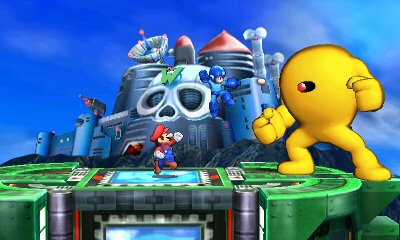
Did I say that I hate Yellow Devil yet?
'Cause I do. I fucking hate Yellow Devil.
Stage bosses and NPCs are a new mechanic of Smash 4; on some stages, a boss or non-playable character may often appear and influence the fight. Examples of bosses include Yellow Devil in Wily’s Castle and the Dark Emperor in Find Mii. Thankfully, those are the only two – Smash for Wii U ditches the Dark Emperor (since he’s from a handheld series), but adds Ridley from Metroid and Metal Face from Xenoblade Chronicles as bosses on the Pyrosphere and Gaur Plain, respectively. (Smash 3DS does have Gaur Plain as a stage, but Metal Face can’t appear there.) NPCs range from characters that can affect the stage (like Kotake and Koume in Gerudo Valley), act as enemies (the ghosts in Pac-Maze), attack fighters (the Pokémon in the Unova Pokémon League), or at their worst, become additional fighters that join the team of whoever gets to them first (like those fucking Flying Men from the Magicant stage). While I can accept that they’re an additional reference to the games these stages came from, many either halt the battle or become an extremely bothersome hazard.

Magicant. See that bird guy on the top right?
It can become an extra fighter. Uninvited.

Some stages have fun extra effects, though; Golden Plains sees a fighter turn golden if they collect 100 coins, and fighters can play along killing birds in Duck Hunt. I’ll also always enjoy the microgames popping up in the WarioWare, Inc. stage.

No Items! Fox Only! Omega Version!
Reminder that none of these hazards can be turned off in single-player modes, so if a stage decides to piss you off during Classic or All-Stars, well, there isn’t much you can do. In multiplayer modes, however, it’s possible to toggle the Omega version of a stage, which… just transforms it into a flat surface, no platforms, no gimmicks, nothing, à la Final Destination. I wished it was possible to only remove some gimmicks from stages, but much like items, it’s “all or nothing”. Either you play the stage with all of its annoyances, or with everything taken out, even any sort of interesting terrain layout.

So, a lot of good stage ideas, many awesome winks to franchises (first- or third-party), I just wished they had shown some restraint on stage hazards as these can really take over the fight and take away the enjoyment. There is such a thing as "too much".

STREETSMASH

Gonna go over this one quickly. Like a lot of 3DS games, Smash has functionalities that tie in with the StreetPass software installed on the console. StreetPass allows players carrying their console around to “meet” other players’ Miis, adding them to a sort of “people you know” list. Smash 3DS took that idea and created a mini-game out of it. You and up to 11 other players can participate to a sort of Token Smash. The characters are tokens, they can move around the board and attack the other players’ tokens. Like Smash moves in regular battles, it’s possible to charge up an attack that will then knock opponent tokens further away. The goal is simple: Knock all of the other tokens off the board, into the surrounding pits. Of course, you need to build up to having 2 to 12 players at once on the board by going out and meeting people. And once the match is over, well, gotta meet people again in order to play some more.

In short:
-It’s a sweet little mini-game, though its relevance to the series is pretty limited.
-It’s the fastest way of making money (since in-game currency is required to buy trophies, play Trophy Rush or increase the difficulty of the Classic Mode), but only when playing against opponents met on StreetPass.
-There’s a Training mode allowing you to play without meeting people, though while it does give a few coins, it’s not nearly as much as when playing against other people met through StreetPass.
-You can edit your profile (have a message for other players, and pick a fighter to represent your token), view your statistics, or play a Tutorial to learn the game.

CHALLENGES

Image taken from this video.
What would a Smash game be nowadays without the Challenges? These boxes of achievements, broken by completing all sorts of tasks within the game (or by using the few obtainable hammers), containing any of the collectibles within that Smash edition. I loved its implementation in Brawl and thought it was a great idea (even though there’s a handful of Challenges I was never able to complete). I especially loved the freedom that came with it; early on, almost anything could open one of these boxes, and late into the game, you had the information on how to open every last one. I was hoping to avoid comparisons with previous or future games from the series, but I can say I was disappointed by the way the Challenges are set in Smash 3DS, compared to Brawl at least.

The Challenges are split in 3 sets of 35 boxes, totaling 105.
  • The first box has very easy, introductory challenges (example: Beat Classic once; use a character’s Final Smash; play any mode a first time);
  • The second one has intermediate challenges (example: Unlock all characters; inflict 100 K.O.s; Beat Mode X with 5 characters);
  • And the last one has the challenges that are either difficult, tedious or time-consuming (example: Beat Mode X with all characters).

I want to do this! What is their secret?
With each set, you can earn three hammers, which are usable only within that set. Also, Set 2 only opens if you completed all of Set 1, and Set 3 only once you unlocked all characters and completed 25 challenges from Set 2. The trade-off is that once you unlock a new set, the challenges already cleared on it open instantly. Lastly, Sets 2 and 3 have a few boxes that can’t be broken by Golden Hammers.

I can once again imagine why the Challenges were made that way; splitting challenges by difficulty does make it easier to figure out what you can complete at one point of the game and what you can’t. I wished it was quicker to unlock the later sets, however.

SMASH RUN

After everyone spoiled the Heck out of Brawl’s “The Subspace Emissary”, Masahiro Sakurai expressed his opinion against creating another complex story or Adventure Mode for Smash 4, since it would just be spoiled once again by players. (As “World of Light” can attest, he would eventually go back on his word.)

That's the weirdest boat I have ever seen.

Gotta pick every single boost!
The alternatives? A Mario Party-inspired mode called Smash Tour for the Wii U version… and Smash Run for the 3DS version. Smash Run has a very simple concept: You pick a character, then you’re thrown into this gigantic platforming world filled to the brim with enemies, with a 5-minute timer ticking down. Your main task is to collect stat boosts, which is achieved by opening treasure chests, going through doors to complete challenges, and killing enemies. The six types of stat boosts increase the character’s attack, defense and speed, as well as their ability to jump and use objects or their special moves. Technically, you’re playing this mode against three opponents (human or CPUs, but you’re never going to run into them while venturing the map.

Enemies from all franchises are in there - even Mega Man!
After the five minutes have run out, all stat boosts collected by the characters are added to their stats, and then you’re thrown into a random one to two-minute challenge. The Smash Wiki lists 17 possible final challenges, most of which are regular Smash battles with special rules, though some are more like races. Free-for-all is the more common setup, but sometimes the four fighters may be split in two teams instead. You can’t focus on a single stat to boost while venturing Smash Run, as you can never tell what the final battle will be; you can be Bowser, one of the heaviest characters, and have to climb a tower. I’m pulling that example because it happened to me during gameplay, FML. You can have a somewhat decent run in the field, then do terrible in the final combat - yet that's where everything's decided. It also doesn’t help that, most of the time, the final fight will last only a minute, two at most, which is usually too short to really have a decent difference in results in that fight, frequently leading to Sudden Death matches among the leading fighters. Then, factor in items or stage hazards…

So our stats have changed - alright, but does it make
a difference in the long run?
Much of the gameplay in the first part will involve fighting your way around hordes upon hordes of enemies, which are attacking from all sides in large numbers. If you’re KO’d (which can happen if you’re thrown too far off-screen), you lose many of the stat boosts you've collected. Bigger enemies drop more loot, while some of the bonus challenges hidden behind floating doors in the arena will award massive amounts of boosts. Events such as boss monsters and new temporary hazards may appear in the arena, making things harder for everyone. In the arena, players may also come across goldor (found in chests along with more stat boosts), trophies or customization items.

Also of note, items have weight and each character has
a maximum amount of weight they can wear, and so all
characters have different carrying capacities.

Speaking of, customization is an option in every mode of the game, but it’s rarely as impactful as it is here – it’s all about gathering the most stat boosts, so you can choose to start Smash Run with a character already equipped with items that change its base stats. You’re encouraged to customize your characters with pieces of equipment before going through Smash Run, since some of these items are additional powers that can be activated. These items will otherwise only affect the fighter’s attack, defense and speed, increasing a stat and decreasing another.

To conclude, as a replacement for an Adventure Mode, this could have been a somewhat decent idea. Shorter, simpler, not at all lacking in references to the franchises of Nintendo. However, it’s got so many problems I can only play it with gritted teeth. Overwhelming swarms of enemies, many of which are either very strong, cumbersome, or have special attributes; completely random boost drops; completely random final battle; said final battle is frequently too short to really declare a winner outside of Sudden Death; I could go on and on, picking examples from my own playthrough. It could have been so much better with a couple tweaks to gameplay here or there, removing some annoyances, that sort of thing. But hey, it could have been worse – I keep hearing that Smash Tour, in the Wii U version, is even more despised!

In Part 3, the "Games & More": Classic, All-Stars. Stadium, Customization and Vault. ->

December 6, 2019

Super Smash Bros. for Nintendo 3DS (Part 1)


Part 1 - Part 2 - Part 3

I haven’t reviewed a lot of games on Nintendo consoles lately; blame it on the overabundance of games I own on Steam. Also, whenever I get a hold of my Nintendo 3DS, it’s usually to play some more Pokémon Ultra Sun (and that one will hopefully get its own article someday). I almost forget that I have other games for the portable console, isn’t that odd? It’s not like I don’t have some big name games either, as I also have the Legend of Zelda: Ocarina of Time remake and Luigi’s Mansion: Dark Moon. However, for the Nintendo experience, nothing beats good old Smash.

Jump, slash, run and swing your way to victory!
Or not.
Super Smash Bros. for Nintendo 3DS (AKA Smash 4), released in North America on October 3rd, 2014, comes from a relatively awkward yet recent era of Nintendo’s history. Ever since the N64, the company has felt the need to release a Smash title for each new generation of consoles. How can we blame them? Every new Smash game feels like a celebration. Masahiro Sakurai’s work on the massive crossover is something worthy of praise, and the numerous additions to the series over time have been, for the most part, well-received (whether it be characters, modes, options, gameplay mechanics… well, except tripping in Brawl; fuck tripping). So, of course, the Wii U had to have its own Smash. And yes, they went all-out; roughly fifty characters, the first instance of DLC characters added to the series, more franchises referenced, more non-Nintendo-borne characters joining the fight.

With that said, I am not too knowledgeable with Smash for Wii U, I never got a chance to play it and experience its modes. I was actually intrigued by the double release for that generation of consoles. Two Smash games released together? And the first entry of the franchise onto a portable console? Sign me up, right? That’s what I thought. And so, once I saw Smash for 3DS at a reasonable price, I bought it.


Smaller screens, smaller stages.
Let's get fightin'.
When the topic comes to Smash, I sincerely refuse to call any game of the franchise outright “bad”. As always, I tend to acknowledge the successes far more than the failures, and even though I have my gripes here or there (read: tripping, no, I’m not letting that one go), these games always seem good to me, if not outright great. People on the competitive fighting game scene might beg to differ, seeing how Melee was the sacred child of the Smash franchise for so long and there’s always been tweaks to physics and character movesets that tend to make these players prefer a Smash game (read: Melee) over another. I am in no way qualified to be a part of the competitive scene; Heck, I can barely get myself to find other people to play this game with. Admittedly, the strength of Smash games is that they’re so chock-full of content, you could never play these games with others, yet still have a good time for months. My own experience with the game allows me to make a relatively complete picture of all it contains, and what I think of each mode. There’s a bit of hindsight in there as well, considering Smash Ultimate was released in 2018 and we now have a more recent release to compare Smash 3DS (and Wii U) with. Still, I will try to rely more on personal experience than comparison with other games of the series.

Without further ado, let’s get into it.

That's only a fraction of the available trophies.
First things first, I’m impressed that they managed to fit so much in a 3DS cartridge. There’s everything you’re used to when it comes to Smash: A huge selection of playable characters, stages, items, guest stars (if you want to call the Pokéballs’ Mons and Assist Trophies that), modes and collectibles. Every time I go back, I realize how much there is, content-wise. Wows all around. As usual, the starting roster is already quite impressive, but it only gets better from there once you start unlocking characters and find out there’ll be about fifty faces on that screen to pick from by the end.

The first downside to having so much content on a single cartridge is that the loading times may feel long as a result. I did feel like there was a lot of loading in Smash 3DS, but considering everything that’s in there I’m willing to give that a pass. An understandable weakness. I would probably less forgiving if I played in multiplayer and encountered lag, which I guess is a possibility. Two points that will also pop up frequently, a fair trade for the console's technical limitations: A lot of options and modes are missing; no Events, no Tournaments, no Special Smash, but that's alright. Also, a lot of modes seem to have been made shorter, which I assume is due to the Nintendo 3DS's battery. Can't have modes that go on for too long, one's play time is fairly limited before they need to recharge the portable console again.

And so we get to my second point of criticism: I hope I’m not alone on this, but I felt that the main menu here was confusing. There seems to be a big focus on multiplayer, or at least multiplayer modes, since regular Smash, Smash Run and Online (with the first two including both single- and multiplayer options) are accessible from the first level of the menu, along with the menu of achievements and the mini-menus for the StreetPass and Wii U connectivity. Everything else, including the Solo modes, are stuffed into "Games & More" along with multiplayer options for Solo modes (All-Stars and Multi-Man Smash), customization, the vault of collectibles, the options, and the Amiibo menu. It’s all organized in a really strange manner. I can understand since the devs had to fit all of these options on the small screen of the 3DS. I also get that they may have favored the multiplayer options over the rest, but still – it’s odd to see the Solo mode relegated to a secondary menu, while the Challenges are on the main menu.

From now on? Each mode gets its own section. First is…

SMASH

Hard to actually show the difference in the game's physics
using still images. Here, look at how big the big guys
are now compared to the average Mario-sized Mario.
I don’t have much to say here, it’s pretty much the same as it ever was. The only difference is that the Solo and Multiplayer Smash options are separate, depending on whether you want to play a match by yourself or with friends. I assume that’s because you’d need to connect with other players of Smash 3DS in order to get a multiplayer match going. As usual, pick a fighter, pick a stage, set the rules just as you want them, and you’re ready to go. You do unlock extra rules after playing the game for a short amount of time. Do you like time-based matches, do you prefer stock battles? Would you like to set everyone’s handicap at 300% to make this a sudden death? Maybe a little bit of all that? Nothing else to say; it’s always been that way. So that’s fine. Of course, the 3DS’s limitations meant having a maximum of 4 fighters in a battle compared to its companion Wii U release’s 8 (in some conditions), but that’s not really a complaint.

Among new additions to mechanics, now an opponent that's
been KO'd will leave a trail the color of the fighter that
KO'd it. You can now figure out who KO'd who!
I would probably need to be more knowledgeable in terms ot Smash mechanics to truly discuss differences between this version and past ones. I do know that Brawl's physics were a little slower, in order to encourage a more party-like gameplay opposite from Melee's much more technical, fast-paced physics. This time around, I could feel like characters had their own differing weights, it was noticeable in how they moved or played, how their speed differed, and how this affected the outcome of battles. It also felt a lot faster, pace-wise, than Brawl. By the dev team's own admission, they were trying to combine the best of both worlds by having the party-like atmosphere of Brawl with the mechanics, better and more suited for competitive play, that were in Melee. I'll let better players than me be the judge on whether it worked, and whether it was a good idea. A few graphical differences were made as well, mostly regarding the size of characters when compared to each other in the roster and previous versions.

Smash is known for some of its modes, yes – but what do people really care about when it’s time to talk about any new entry in the series? Well, the roster, of course! It’s at the basis of everything Smash. Along with the famous Nintendo figures (and an increasing number of third-party fighters as well), items and stages keep getting added to double down on the massive crossover’s list of references. I figured I would close Part 1 of this review with a look at, and what I think of, the roster as well as the items of Smash 3DS. Stages will be in Part 2.

THE ROSTER

To say that Smash 4 (on both versions) went all-out would be an understatement. Up from Brawl’s ~39, Smash 3DS/WiiU ups the number of combatants to… um… depending how you look at it, 46 to 58. That’s a lot, and it certainly felt impressive at the time. 

So many faces  I can barely remember all their names.
Doesn't help that most Fire Emblem folks all look
like average shoujo protagonists.
Let’s break down the “46” first, I’ll explain the “58” later. Of these, 34 are returning from any of the previous Smash games. The original 12 are still there; Dr. Mario, Mewtwo and Roy return from Melee (the latter two as DLC), and most folks from Brawl are also here again. The absentees? Wolf O’Donnell, Snake, the Pokémon Trainer (Charizard’s in, but Squirtle and Ivysaur aren’t). Oh, and the Ice Climbers, due to the technical limitations of the Nintendo 3DS (though it means they were also out of the Wii U version). Toon Link is still in as Young Link’s replacement, and Pichu is yet nowhere to be seen.

Among the base game’s newcomers (and the DLCs discussed below), franchises making a first appearance here include Animal Crossing, Wii Fit, Punch-Out, Duck Hunt, Xenoblade, and for third-party characters, Mega Man and Pac-Man. The Miis (if you want to include them as a franchise of their own), are here too, available in Brawler, Swordfighter and Gunner flavors. Metroid and Kid Icarus, previously represented by a single character each, have new representatives as well (Samus is split in two characters, while Dark Pit and Palutena join Pit).


Seven characters in total are DLCs: Aside from the aforementioned Mewtwo and Roy, there’s also returning brawler Lucas, and newcomers Corrin (from Fire Emblem), Ryu (from Street Fighter), Cloud Strife (from Final Fantasy) and Bayonetta (from… well, Bayonetta).

Now, why the “58”? Well, some of these 46 characters have alternate outfits that are actually different in more ways than just the color; some of these are bonus character options. Fire Emblem representatives Corrin and Robin are available with both male and female models. So are Wii Fit Trainer and Animal Crossing’s Villager. Then Pikmin’s Olimar has Alph, one of his colleagues, as an alternate costume/fighter. The “holy crap” award, however, goes to Bowser Jr., newcomer from Mario’s side of the family, who has all SEVEN Koopalings as alternate costumes. WOW.

Good thing they all count as a single character.


Gee, I wonder who that is!
One of my favorite aspects of Smash is the possibility to unlock characters as you play, until you get the full roster – I am a little disappointed that there are only 12 characters that may be unlocked by playing the game this time (Then again, the Wii U version has it worse with only 8 unlockable characters). Some of them can be found either by repeatedly playing through Classic Mode on varying difficulties, but all can be unlocked by playing a numberof VS matches. The numbers of VS matches required are much smaller than in previous installments: only 120 to unlock Jigglypuff in Smash 3DS, versus 450 to unlock Wolf O’Donnell in Brawl. On the other hand, fewer characters to unlock means more options from the get-go. I also can’t forget that, of the 46 characters, 7 are behind a paywall.

"Aren't you me?"
"We're separate characters now."
"This is gonna get confusing."
"You have your name, I have my alias. Simple enough."
Another difference that disappoints me a little, but at the same time I feel it was an inevitable change: Characters who were once able to transform no longer can, and fighter transformations are new spots on the roster. Zelda and Sheik are separate characters now. Same for Samus and her Zero Suit form. I guess the alternate fighters as costumes were a good trade-off for that limitation. The other Final Smash transformations remain, however.

Overall, I’m fairly happy with the roster. There’s always the critique of there being too many new faces for one franchise while others are left without new representation. Three more Fire Emblem characters – Lucina, Robin and Corrin; two more from Mario – Rosalina and Bowser Jr; meanwhile, still not a trace of my favorite boy, Mike Jones from StarTropics! Once more, we were given new fighters that were either obvious choices, fan requests, or unexpected additions, and we're finally getting coverage for franchises that had yet to make an appearance. We aren’t missing a lot of veterans either, and the ones who originally had movesets too similar to other fighters’ saw an improvement and new attacks to distantiate themselves from the originals.

It also helps that you can customize all fighters by giving them new attacks, some of which you earn by completing challenges and clearing game modes. Don’t like a character’s down-special? You can swap it for another. I don’t really use that functionality, but it’s there for those who aren’t satisfied with a fighter’s attacks. Customization really is the name of the game here. I'll discuss this further in Part 3.

THE ITEMS

Any idea what to use for the best experience? I know! Only hammers.
The longest enduring meme of Smash might be “No items! Fox Only! Final Destination!” Yet, items are a key element of this crossover party fighter. No less than 71 items exist in the game in order to spice up these scuffles. They range from classics that were there since Day 1 on the N64 to additions paying homage to newer series as well as classics of gaming – and not just Nintendo, either, as Namco-Bandai gets a few references in there, thanks Pac-Man. The item screen in Smash 3DS is split depending on the type of item:

  • The Smash Ball for Final Smashes;
  • The helper items (Assist Trophies, Pokéballs and Master Balls);
  • Objects split in three parts to be collected in order to use their devastating effects (the Dragoon and Daybreak);
  • Containers such as crates;
  • Items that transform the character in some way;
  • Items that allow the character to punch/slash/shoot at others with added effects;
  • Items to be tossed around;
  • And last but not least, a handful of accessories.

Like in past games, you can turn on/off every item individually to customize the battle as you see fit.

My first problem here: Unlike past Smash games, you can’t set a rate at which items appear: It’s all or nothing. No gradation. If I recall, in Brawl one could choose a frequency at which items would spawn; None, Low, Medium or High. Melee had even more options. Here? On or Off. Have fun seeing either not a single item, or loads of items. I'm not sure I can blame console limitations here, either, as I think it would have been simple to implement.

Other observations:

Majestic! Silph worke dovertime to produce so many
Master Balls!
-I like that Pokéballs and Master Balls are now separate items, so you can play a match with nothing but Legendary Pokémon (and the occasional Goldeen) appearing if you want to. At the time of Smash 3DS’s release, Gen 6 had just come out, while Gen 5 came out after Brawl’s release, so both get some representation – roughly 13 Pokémon from those two Gens, along with many fan favorites returning. The new Assist Trophies are pretty cool too, by the way. I was very surprised to see Pong among the allies one could summon.

When I said BFG, I meant it.
That's one big freaking gun if I ever saw one.
-A number of Final Smashes (FS) have changed from Brawl to Wii U/3DS. I leave it to the metagame to decide whether all of these changes were good things; though generally, new Final Smashes tend to make a bit more sense on the characters using them. Charizard, Mewtwo and Lucario gain access to their Mega forms, Luigi now uses the Poltergust, Pit equips himself with the Three Sacred Treasures instead of calling an army of angels, R.O.B. swaps his diffusion beam for a BFG. Zero Suit Samus has a new FS of her own, since Samus’ original FS involved her ditching the suit or putting it back on after attacking.

Boss Galaga is one of the reasons why I'm starting to
believe in the "No Items, Final Destination" meme.
I'm not quite at the "Fox Only" part, though.
-Smash had no shortage of ultra-deadly items in the past three entries (the Hammers, some Assist Trophies and Pokémon, among others), but Smash 3DS literally introduced two items with the potential to insta-kill characters. First is Boss Galaga, taken from the famous arcade classic. When launched, it will fly around with a tractor beam. A player caught in the beam will be dragged upwards into the upper blast line. Unless the captured character is punched out of the beam or wrestles out, it’s gonna die. Guaranteed. A second item, the Lanayru Beetle, does a similar thing, also dragging a fighter upwards to kill them once it catches them. Multiple times have I been killed in Classic because the enemy got to either of these first and threw it at me. This is the new tripping for me; this ruins battles. This can turn the tide of battles in unfair ways. I hate these items.

The last time I fought winds this nasty, I was battling Wario!
-The ability to push enemies away wouldn’t seem that great in a fighting game, but in Smash, where you just need to send someone too far in any direction, it’s too good. The Ore Club can create tornadoes after successful smash attacks, while there’s an entire item, the Gust Bellows, dedicated to pushing others away. These two can coexist in one battle. Trap someone close to a side blast line, and keep pushing them towards it, and boom, easy win. Urgh. Not as bad as the insta-kill items, but still really goddamn annoying.

-So. Many. Bombs. Too many, in fact.

Using screenshots from the Wii U version...
Is that cheating? The items remain the same...
Although, there’s a number of good additions among the items (the Super Leaf, Spiny Shell, Special Flag, Rocket Belt, POW Block, Drill and Boomerang are ones I like). I do like that they keep adding items from franchises that either had very little or no representation at all, some obscure series in particular. I don’t have good words for every new item, but while I bitch and moan about details, most additions are actually good.

In Part 2: The Stages, Streetsmash, the Challenges, and Smash Run. ->

August 15, 2016

Worst 12/Top 12 Sports in Mario & Sonic At The Olympic Games

I’m back with a new list! Boy, I haven’t made a double list of the worst and the best in the same game in a long while… Mario and Sonic at the Olympic Games contains 24 sports, which means I can classify them in two lists of 12: The ones that I don’t like much, and the ones I like. You know how it goes; I get rid of the negative first, with the Bottom 12, and then I get into the Top 12 to end on a high note. I had to replay every single sport of this exhausting game in a matter of a few days to compose these lists, just for you. I hope you’re grateful. How about we get this started?

THE WORST SPORTS

12. Dream Fencing
The Fight To End All Fights! Danger! Thrill!
Epées! No epicness whatsoever!
I find both fencing sports to be very middle-of-the-road in this collection. Neither is particularly great, neither is terrible. As a result, I was trying to figure out which one was worse, to put it on this list. I went with Dream Fencing because it has a scoring system different from regular fencing; in regular fencing, you must hit your opponent a certain number of times before they hit you that number of times themselves. In Dream Fencing, characters have life bars and a character wins when their opponent's life bar goes empty. When getting hit or sparring attacks, they have a gauge that fills up. When it’s full, that character can use a special move. This can make some CPU opponents, which can already be fairly difficult to defeat in normal fencing, a little harder. And of course, you can use these attacks too, but a CPU character will know what the best moment is to use their special move, and they might activate theirs right after yours, stealing your chance to win…

11. 400m
Maybe you're gonna be able to escape from Bowser
the next time he tries to kidnap you!
Keep winning that 400m event, Peach!
I mentioned I hated the “exhaustion meter” in the previous part, didn’t I? Expect it to be mentioned a few times here. Running the 400 meters requires that you shake your arms for a rather long period of time. I mean, if you don’t think 40 seconds can be long, go play that mini-game and come back to me. It would already be bad enough, but the exhaustion meter takes it to a new level; if it empties completely, your character will need to catch their breath and you’ll lose seconds. Your character spends most of the mini-game teetering on the edge of exhaustion, with your movements trying to make them run but not get too tired… Pressing the A button to get a boost in the final 100 meters, as they tell you to, will likely not help. On the contrary, it might give you more trouble.

August 12, 2016

Mario & Sonic at the Olympic Games


The 2016 Olympics in Rio are in full force! Many TV channels are talking at length about the many, many competitions that have been taking place since August 5th. Obviously, there’s money to be made with the Olympics in the video game industry as well, and thus Nintendo jumped on the occasion in 2008. After all, the Wii’s motion-detector controls would certainly allow the gamers to get more active, right? There are many other games out there that force the player to get up and exhaust themselves in front of the TV, but this one managed to separate itself from the others by featuring already-famous video game characters: The Mario & Sonic at the Olympic Games series. With one game released every two years, for both summer and winter Olympics, this had to be a winning decision!

But wait… why Mario and Sonic, exactly? Well… there can be many reasons to bring the rivalry between these two mascots into the Olympic Games. For starters, Mario and his crew have always loved to play various sports, from the NES era to now. Golf, go-karting, tennis, baseball, soccer, hockey… The list goes on. As for Sonic’s franchise, it’s a lot less prone to make spin-offs based on sports, and they practice very few sports outside of those that requires speed – like the Sonic Riders series. However, the characters of the Sonic series are a lot more active, in a way. They explore, they climb walls and jump left and right all the time, Sonic almost does parkour in some games… The Sonic crew is physically active, even the less action-oriented characters, which makes them perfect for a sports competition. Doesn’t explain how Eggman’s body allows him to keep up with everyone else, though.
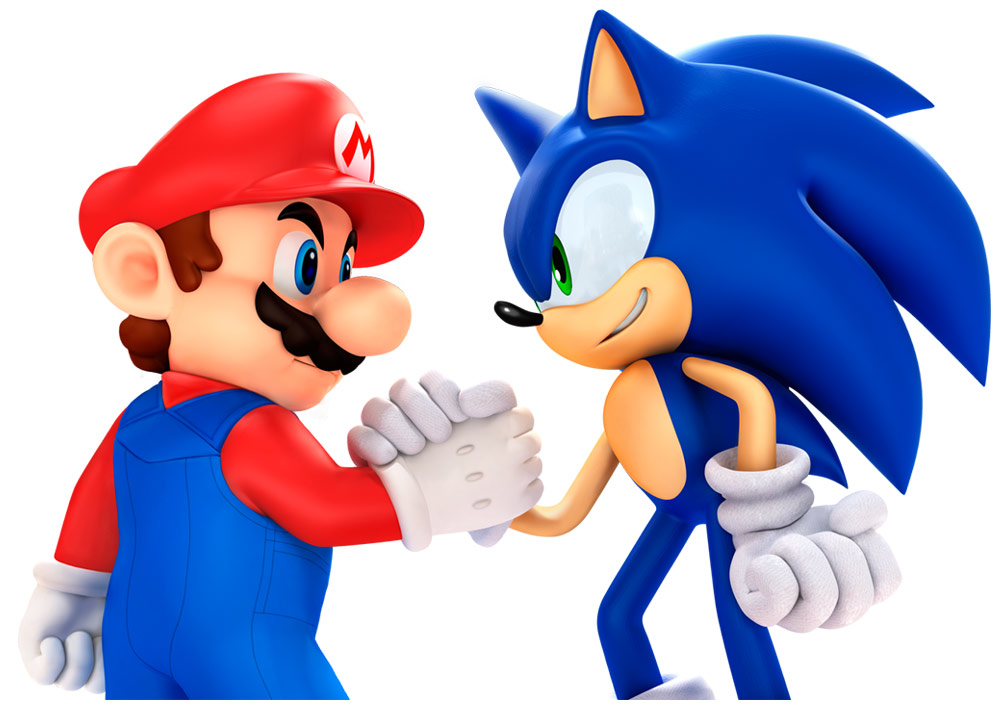
Can't get more symbolic than this. Remember, kids:
Mario and Sonic encourage good sportsmanship!

Then, there’s also Mario and Sonic’s rivalry spanning decades already. This is a clash everyone wanted to see, the battle to end all battles… as a 100-Meter race, a trampoline skill match, a javelin-throwing competition…. Hey! Where’s the Fight To End All Fights between these two giants of the gaming industry? Oh, you’ll get one… as long as you don’t mind it being a fencing duel. If you want to see these two duking it out, pop in Smash Bros. for Wii U/3DS, or Brawl. These video game mascot Olympics will be as friendly as can be. Probably as a way to avoid tipping the balance on a side or another, seeing as both the Mario and Sonic fandoms would be convinced that their side steamrolls the other in an actual fight. Never underestimate the power of fanboys to argue all day on who would win in a hypothetical scuffle. Everyone here has been given stats preventing them from reaching the full potential they exhibit in their home series – in particular folks like Sonic and Shadow, who were considerably slowed down. You can lose a 100-meters race while playing as Sonic here, how unbelievable is that?


Alright, enough discussion, let’s jump right into the game. There’s not a plot to speak of, so I’ll mostly go over the different modes and competitions. When you open a save file, you type a name and then choose a country of origin, the country to represent at the Games, and then we get to the menu.

June 2, 2015

Wii Sports Resort (Part 2)

Read Part 1 here!

Hey guys and girls, welcome back to my review of Wii Sports Resort! …For the Wii. It’s still a pretty basic game, with the main draw being to play sports for fun, Pro mode or achievements be damned. Well… that’s partially true. You can try to play for those, although it’s anything but necessary. And yet, some sports contain some form of progression. That’s odd, but try to follow me on this one: There is no overall progression to this game, no “100% completion” to speak of, and everything is optional… At first, you’ll just unlock variations on the sports, but then you’ll notice some of the variations are divided into “levels” of sorts. Here are some examples:

There are too many.
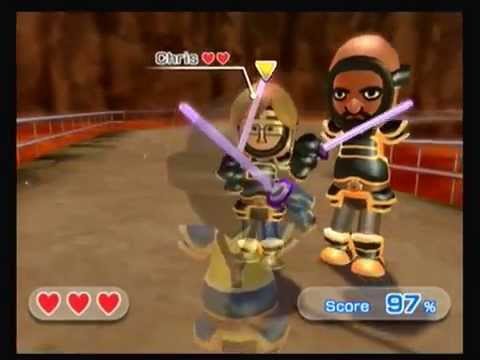
-When you unlock Showdown in Swordplay, at first only one of ten levels is available, and you unlock each level by beating the one that came before it. For obvious reasons, every new level is harder than the one before. I haven’t been able to beat the seventh level so far…
-In Archery, you unlock Intermediate by beating Beginner, and you unlock Expert by beating Intermediate. Pretty usual stuff, really.
-There are six levels in Power Slalom. All but one are locked at first. And of course, the later ones take place on dangerous waters, because for some reason the makers of this resort island want to kill you. Thankfully, no Mii can actually die, so I guess they resort (pun) to option number 2: Injure or maim the Miis as much as possible!
-Bicycle races start off as six short trips, then two longer trips consisting of three short trips each, and finally a giant race comprising all six parts. You snooze, you lose!

Facing off the champion? Better hoe you're ready!
So, in a way, there is some form of progression in the game (unlocking everything), and yet at the same time there isn’t. You’re not bound to go Pro everywhere or get every single achievement. AND YET… oh yeah, this Shrodinger’s Challenge is gonna get even more complicated. When you become Pro in a VS sport (as in, 1-VS-1), you’ll end up facing that sport’s Champion, and you’ll get some small rewards when you manage to beat him/her. However, most of the time, when you beat the champion you’ll just unlock an extra mode or get another cosmetic award. Just try to imagine that: Advanced Frisbee Golf, advanced Golf, advanced Archery! Isn’t that great? You can play basketball at night now! AT NIGHT!

May 29, 2015

Wii Sports Resort (Part 1)


After I finished my rather, uh, abrasive review of Mario Kart DS last Monday, I realize I was still in the mood for a sport game. Mario Kart is, after all, a very silly version of racing, what with the power-ups, the shells, the other items, the ******* powersliding, and so on. It’s as far from real racing as a chimp is from a squid. That’s weird, I wanted to do something sports-related. Just Dance 2015 was just waiting there for me. So I went ahead and played a couple songs… and then went on to try playing the old Wii Sports game again. Because I’d rather play video games than do real sports.

Oh, no worries there, it’s still fun aplenty. Sure, compared to everything else people have come up with for the Wii, it’s far from impressive. But still very enjoyable for a quick bowling match, or to hit a few balls. Maybe even a tennis match, if you’re in the mood. Or perhaps would you prefer to play golf? For maximum enjoyment, also try out the Training section!

Anyway, the game, which was shipped with the Wii for a couple of years, soon found itself outclassed. Then came the idea of MotionPlus Wii remotes. Those little blocks were originally plugged into the remote and were supposed to ameliorate the movement detection. As a result, the later Wii remotes all contained MotionPlus when you bought them. And I can understand why; who doesn’t like it when the remote works even better than before? However, when the MotionPlus thingy was put on the market, we ended up with a few games that specifically required it; as a result, you couldn’t play these games with the old remotes. It's the case for today's game.

As for Wii Sports Resort itself, just admit it: The original Wii Sports had only five sports, and you could get tired of it pretty fast. The "series" desperately needed a new installment, one that expanded on the idea of Miis playing sports for fun, one that would offer a larger selection of sports, with achievements, variations… Nintendo of Japan didn’t even wait for us to ask. And indeed, we received. Wuhu Island is waiting for you. Let’s dive right in… Wii Sports Resort!


December 20, 2013

Wii Music

Hurray, it's Christmas in five days! As you certainly know, I'm a big fan of music. I'm also a big fan of music inspired by video games, or, Heck, music that serve as score in video games. I'm less a fan of Christmas music, but that's mostly because many songs keep airing on the radio channels since the 1st of December, and they're repeated until I get sick of them. But that doesn't mean I'm not in the Christmas mood! The most aired Christmas songs anger me, but I enjoy the ones we don't hear as much. And besides, there's plenty of good Christmas TV specials and Christmas movies to enjoy. Want to make me a Christmas gift? Subscribe to the blog's Facebook page! That would be the greatest thing you can do for me, dear reader!

But now, I'm straying from the point.

Since I love music so much... and since I didn't have time to think up a little Christmas story to post on the blog... well, I decided: Why not spend the Holidays making reviews of my musical games? Okay, I have three: Wii Music, Just Dance 3, and Rock Band 3 DS. As you can see, I had plenty of choice... Well, why not begin by the lesser one of the bunch?

It's not an insult to Wii Music, except... unlike the Just Dance series, which bases itself on making you exercise and gain rewards according to your talent, and the Rock Band series, which just... um... ROCKS, Wii Music just seems like the least great one of the trio. So, hey, why not start by that one? You'll see what I mean as I explain the details of the game.

November 15, 2013

Wii Sports

Maybe I'm trying to aim for something too big, this time around... Maybe my goal is too high... Eh, whatever. Here's Wii Sports, everyone!

Yes, Wii Sports, the best-selling video game of all time. The game that was given with every Wii in the early days of the console. A game that is dearly remembered in our hearts, as it made every Wii player discover the movement detection and all the things you could do with it. A game that not only let the younger gamers have fun, but brought their parents – and grandparents! - into the infinite pleasures of gaming. It is a game... that defined a generation. Both a generation of consoles, and a generation of players. And it has left a trace in recent history. It is, truly, one of the greatest games, of all time.


Just kidding!

You thought I WAS serious? Oh sure, all this is true, so I might very well have been. But when you think about it, Wii Sports was among the very first games that used the Wiimote and the Wii's movement detection. There were a few games before that experimented this, with EyeToy for the Playstation. Yet, never before was there any console based entirely on this.
As a result, Wii Sports was one of the first games created with specifically the Wii's movement detection in mind. Therefore, the technology was still being perfected. Plus, the only reason Wii Sports is the best selling game of all time is because it was sold along with the first editions of the Wii. And it was also available on the market. This contributed to its status as best selling game of all time... But is it really such a great game?