Watch me on Twitch!

Streaming on Twitch whenever I can. (Subscribe to my channel to get notifications!)

August 4, 2023

Freedom Planet


Every once in a while, as I play through a set of games for Quick Reviews, I stumble on a game that I feel deserves a full-length article rather than a short one. I always knew this game would be one of them. In all fairness, it’s one of those names I had heard aplenty, owned in the collection (it’s been sitting there, waiting to be played, since June 2017), and even talked about in the past. One of this game’s main characters, Sash Lilac, is playable in Indie Pogo, a fighting game I covered back in 2019. Yeah… This one was a long time coming.

The characters and the style really carry that
"Japanese import platformer" feel...
even if the setting is closer to medieval China.
A creation of studio GalaxyTrail, Freedom Planet was released to Steam on July 21st, 2014, though it already existed prior to that. A Kickstarter campaign was also created in order to help its visibility and make it available to as many platforms as possible (the game would be released on Mac, Linux, Wii U, PS4 and Switch as well). Its creators openly admit to have been inspired by multiple gaming franchises, and that inspiration can be felt throughout. The main one? Sonic the Hedgehog (this project began life as a Sonic fangame before gaining a life of its own). Notes of Mega Man and Gunstar Heroes can be felt as well, with the end result giving equal ground to speed and combat. It’s a platformer rendered in gorgeous pixel art from start to finish with endearing and comical characters, with an interesting plot to boot (that you can play without if you don’t feel much for story). In fact, not unlike the Sonic Adventure games, you can play through the story with three different characters, and the stages they go through will change based on the events of the story – therefore, it’s worth playing through thrice.

But I’m getting ahead of myself. Let’s dig in, shall we?


A Tale of Three Kingdoms… And A Universe

Long ago, a giant dragon, a creature of great might, landed in the world of Avalice. Amazed by it, the denizens of the world built three kingdoms in its honor: Shuigang, Shang Mu and Shang Tu. In thanks, the dragon transformed into a large pearl known as the Kingdom Stone, an artifact of immense power and energy, to be shared among them.

Considering this is how the game starts, some of the more
brutal scenes later down the line don't feel that out of place...
Cut to the present day: Galactic conqueror Lord Brevon, who has taken over multiple worlds across space, has crashed his vessel on this world. Seeking a way to leave and hearing about the massive power of the Kingdom Stone, he sends out his army to attack the castle of Shuigang. He kills the King and brainwashes the son, Dail, into doing his bidding. The panda son swears to find his father’s killer, while actually working for said killer. Geez-us, that starts DARK. Dail sends machines out into the other kingdoms to steal their energy for his new boss, and war seems on the horizon between the three lands.

July 29, 2023

Announcement!


Today is my birthday and yep, I got one of those now! Along with a selection of 6 games already. So, you can definitely expect some reviews of Switch games in the future! And not in the far future, either. Perhaps even one of them will be covered this year, who knows?

Which games? Well....
-Octopath Traveler
-Pokémon Legends: Arceus
-Saints Row IV: Re-Elected
-Super Mario Odyssey
-Super Smash Bros. Ultimate
-WarioWare: Get It Together!

And likely more will come!

July 27, 2023

Quick Review: Dimension Jump


(should've posted this yesterday, but I forgot!)

It’s weird whenever I stumble upon a game in my collection that’s no longer available for sale. Makes me wonder why. It is the case for today’s game.

Change the dimension, and that floor blocking the way
no longer exists.
A creation of Redpoint Games released on March 15th, 2017, Dimension Jump is an 8bit puzzle platformer. You move left and right with the arrows, jump with up. The game’s main mechanic involves swapping between two “dimensions” by hitting either Z or Space. A level can change quite a bit between dimensions, and you quickly learn to swap even while in motion, mid-jump often. The game uses very simple color coding: Pale grey is a free space to move in, black is a wall, the goal to reach is green, and touching red is instant death. Doesn’t matter how you get to the green area, as long as you get there and don’t die on the way – you have only one hit point.

The whole game is comprised of nine sets of 10 levels, and each set adds a new mechanic to the mix. The first ten levels set the basics. The second set of 10 remains close to the themes here, adding + and X buttons that force you into one of the two dimensions and blocks your ability to swap by yourself; however, you can hit a button with the symbol opposite the one you last activated in order to swap back. Following this, the next additions are standard puzzle platformer fare: Squares that, when hit, spin the entire level around 90 degrees; blocks that our character can break by falling from high enough; boxes to move around; a power-up that gives a one-time ability to instantly teleport to the other end of the room in a chosen direction or through a wall; and so on. You get the hang of the new mechanic quickly, with only the increasing difficulty standing in your way.

Dimension Locked? Looks I'll have to make do.

Is beating the 90 levels not enough? For an added bonus, you can try out the Challenge variants to each of them. Not enough? Each level comes with two collectible stars, one for beating that level in a certain amount of time, another for picking up a star that appears in that level after you’ve beaten it once.

Coming through! ...Literally going through the wall, yes.
That’s… uh… about it, really. As simple as it gets, and that reflects in both its look and base gameplay. Despite the simplicity, the game shows its true colors in difficulty quickly enough. Piling on new mechanics while you still have to think in two dimensions. It quickly becomes a meat grinder (…pixel grinder?) as you die over and over trying to figure out how to reach the goal. Some later stages require pixel precision – and the fan-made levels are even harder in that regard. In the end, the game merely suffers from not being notable in any peculiar way in the tough competition of Steam's puzzle platformers. (Seriously, do you know how many of those I reviewed?) All in all, not bad, but not quite the memorable experience.

I’d say try it out if you own it and haven’t tried it… I can’t really say “buy it if you wanna”, since it’s no longer for sale… dammit, what am I to do now?

(The Quick Review I was planning for Friday has morphed into a full-length one, so it'll take me some time to finish it - expect it Friday next week. I'll try to slip in another Quick Review until then in the meantime. Also, I might have an announcement this coming Saturday, which also happens to be my birthday. Stay tuned!)

July 24, 2023

Quick Review: Chime Sharp


Not your average music game, in that the music is more like garnish – but that’s okay if the idea is novel enough.

Squares! Ever-bigger squares!
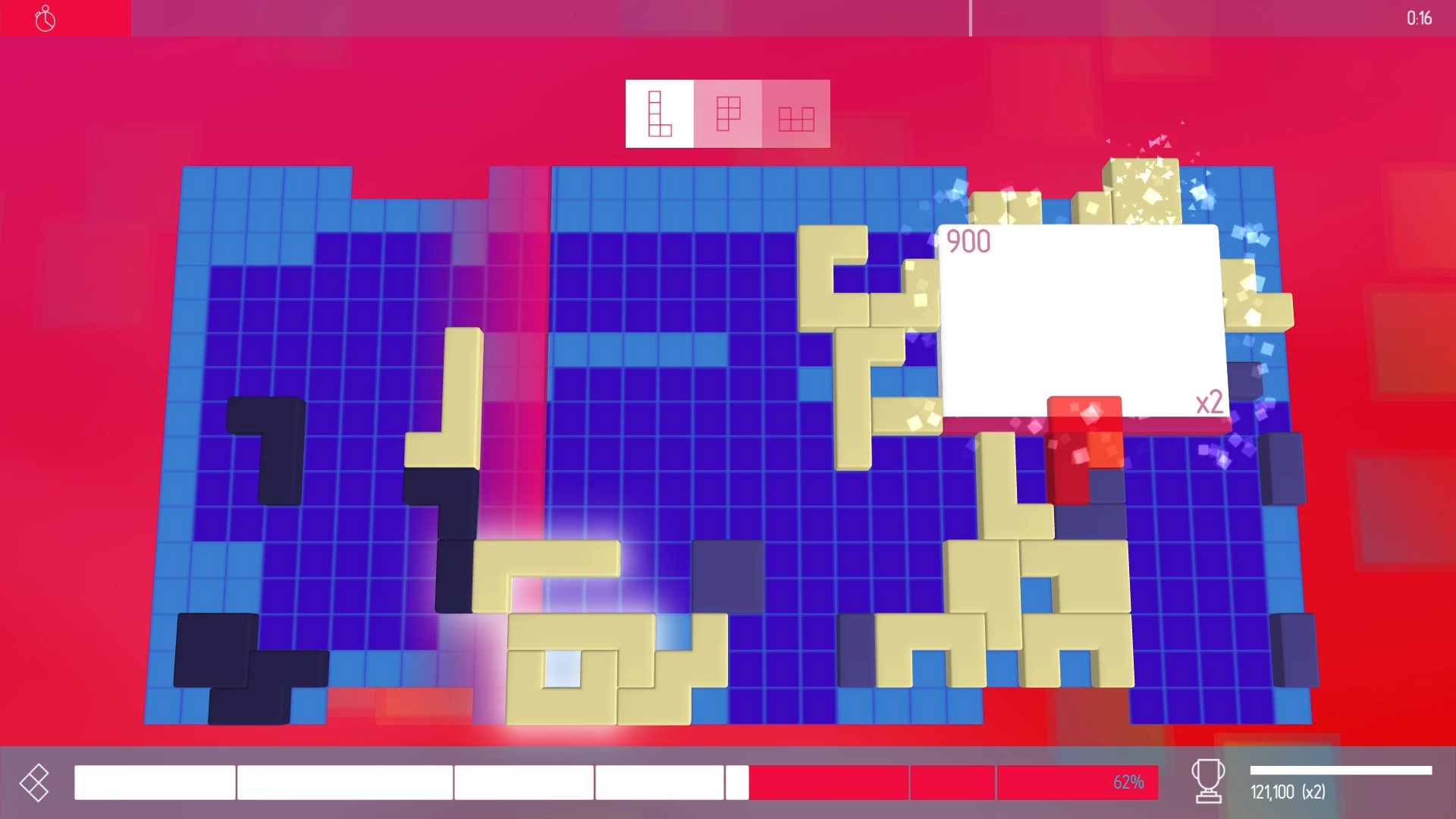
Developed by Ste Curran and Twistplay, published by Chilled Mouse and released on July 19th, 2016, Chime Sharp is a game that’s like… er… no combination of existing titles does it justice. Let me try to explain it, as it’s a bit tricky to discuss even with screenshots on hand. In short, while the stage’s song plays, you set on a field of square a succession of pentominoes. (You know tetrominoes, the figures made of four squares, most famously used in Tetris? Same, but with five squares.) Each stage has its own set of pentominoes, and those available can differ from a stage to another. You have to place these pieces on the field and form "quads", squares with a minimum size of 3X3.

The pale blues are sections where a quad once stood.
Meanwhile, two quads still exist on the grid.
A square or rectangle created this way will fill up with a timer bar, and while it isn’t full, you can keep adding pentominoes to any side of it to increase the size and score value of the area you’ve made. With each successful size increase, the in-piece timer resets. But wait! What about the music? Well, here’s the interesting part. Once a successfully-created area’s timer has run out, it will stay in place. Meanwhile, as the music plays, a beat moves left to right across the playing field and deletes the finalized squares and rectangles, leaving empty squares of a new color in their place instead. You thus have access anew to that space to create new squares. Any bits from pieces placed that weren’t part of a square will stay there, becoming roadblocks in your attempts at placing new pentominoes to make more points. The game keeps track of the percentage of squares on the playing field whose color has changed, with a base goal of 60% necessary in each stage in order to unlock the following game mode. The BPM of a song playing in one stage influences the speed at which the beat/wave moves through, and the playing field can also be different at times, with spaces in which you cannot fit any pieces.

Music's pretty fine, at least.
The end result involves a lot of spatial puzzling, a lot of quick thinking, and pretty good reaction speed as well. Everything is done with the mouse; left-click to place a tile, the wheel to spin it around. Can you grow a square big enough for a major score, and keep it big before it vanishes? Can you actually fill up 60% or more of the grid?

Other modes further play around with the concept, upping the difficulty. As an example, the Sharp mode, unlocked after getting 60% coverage in a song’s Standard version, has the “beat” going left to right instantly deleting the squares created, rather than giving them time to solidify. And so on; to unlock a stage’s Strike Mode, you need to get 60% coverage on Sharp Mode, and for Challenge Mode, 60% coverage in Strike Mode. As for new songs and stages, those unlock the more you play.

As you can see, I haven't unlocked all of the
songs yet. Not sure I ever will, to be honest.
I still feel like I gave the game fair dues, overall.
I always get a little leery when discussing games that I don’t think are bad per se, just not to my interest. It happens! Decent game, and though it’s disappointing that it didn’t grab my attention more, I can at least recognize the effort. Maybe I’m lacking a little too much in musical theory to actually notice how the music changes to the squares you add to the playing field. Good concept, pretty fine execution and a lot of modes for each of the 15 stages… But that’s about it. The game notably doesn’t come with options regarding sound and volume, and you can’t add your own tracks for a customizable experience. That said, it’s perfectly fine for what it is and accomplishes what it wants to do. By all means, if it intrigues you, do check it out.

Chime Sharp is available on Steam for 9.99$ USD.

July 21, 2023

Quick Review: Carto


I’ve heard of games where you make your own maps, this takes it to the next level.

This is like the start of an animated film.
Developed by Sunhead Games and released by Humble Games and XD on October 27th, 2020, Carto is the story of the eponymous young girl, who lives in an airship with her grandmother. The lady owns a magical map, which she can use to remake the world below to her whim by swapping around square pieces of land. One night, Carto sneaks behind her back and plays with the artefact, accidentally causing a nasty storm that throws both herself and the magical map out of the airship. Now equipped with nothing but said map, but able to modify the world to a reality-warping degree, the little girl embarks on a quest to go home.

One map piece after the other, till we've put the world
back in one piece! (....That never happens.)

    That girl by the lake wasn't there earlier! Hi, new girl!
Carto moves around with the arrows, picks up items with Space, and uses items with W. Press Tab to enter Map Mode, where you can move map pieces around with the arrows, rotate them with A and D, or add some of the newly-acquired pieces with W. Map-making follows a few rules. The big one is that you can only stick map squares together if their connecting sides are identical (plains with plains, forests with forests, water with water, etc.) This extends to special elements such as roads and rivers.

I found this place (and this sheep) by making a + shape
with all the patches of white flowers pointing to the center.
Suddenly, new square!
A major puzzle element here involves not only making a path for yourself, but often placing tiles in a specific manner to make something appear – either a brand new tile, or an NPC. Last but not least, swapping a tile with Carto or an NPC on it will also teleport them around. One example in Chapter 3 involves making a circle out of four bending river paths, which causes an NPC to appear inside it; but then you also have to move Carto around so that she ends up within the circle, since she cannot cross water otherwise. Several clever takes on that idea are employed throughout.

Almost there...

Now if this desert could stop rearranging itself
every few seconds...
At some point, the challenge becomes to decipher the little clues that are given to you by the NPCs and the surroundings in order to figure out what to do next. Notably, you’re never at risk of running out of space moving squares around, so you can spread them around however much you want while you rearrange the map to get where you need to go. Later chapters introduce concepts such as undergrounds where your map doesn’t work (forcing you to figure out how to swap the squares of a floor you don’t see at the moment), moving squares together to form images (like putting a lake in the form of a fish), or having entire tetrominoes to swap around instead of squares.

Even in the cold, these paper sheets survive.
Good thing too, we need them more than ever.

It's cute even when little Carto dangerously slips ands slides
across an icy surface! Careful kid, protect your head!
Hands-down the cutest game I’ve played so far this year, bustling with charm, Carto is one of a kind. Not just in its gameplay mechanic that I’m fairly certain has never been done before – or at least never to this extent – but also in how simple its story is, and how both lovingly combine into one. At its core, the plot is all about Carto making her way through the world in search of her grandma, and meeting various new cultures with their peculiar customs. And as her horizons expand, so does her reach, hence the new map pieces. You can even gather puzzle pieces by completing side-quests, which have their own secret at the end of it all. Definitely worth your time, especially if you’re looking for new cutesy puzzle games with unique challenges to offer.

Carto is available on Steam for 19.99$.