Watch me on Twitch!

Streaming on Twitch whenever I can. (Subscribe to my channel to get notifications!)

November 5, 2021

Quick Review: Etherborn


Voiceless body seeks bodiless voice that constantly waxes philosophical.

A whole new way to climb a tree.
Developed by Altered Matter, published by Akupara Games and released on July 18th, 2019, Etherborn is thankfully much more than what I just described. At its core, it’s a puzzle platformer in which the voiceless human-shaped lifeform explores floating masses on their search for the voice previously mentioned. The main gameplay element is the ability to shift gravity, on the condition that the translucent body walks on a floor curved towards the angle where it wants to go. It cannot change its gravity otherwise. Said changes to gravity also extend to its falls, so you can step off the platform while upside-down and fall upwards. It’s disorienting, but it’s part of the experience.

Dodecahedrons can make enormous parts
of the world move around.

The second part of the puzzle is to retrieve little dodecahedrons and then place them on squares so they’ll modify the level they’re found in. Sometimes they’ll merely make a platform appear or move a piece of the level forwards or backwards… Sometimes they’ll summon an entire, new, gigantic piece that will perfectly interlock with the rest.

This cube was a bigger headache than
a Rubik's.
The entire game is a gorgeous visual spectacle. The setpieces are very impressive, seen from all sides. The first level past the tutorial, as an example, involves pieces of bridges, and you move from one to the other by taking advantage of the changes in gravity. There aren’t a lot of levels to the game, but they tend to be fairly lengthy and split into sections. Some of the visuals look lifted right out of a prog rock album cover. You’ll also have plenty of time to take in the sights, as most of the sets are huge and the body, even while running, will take a while to go through them.

Shifting gravity: As easy as walking up a hill!
Of note, due to the constant shifts in gravity, the body can rarely move in a straight line. It’s a bit tricky to control with a keyboard and WASD, the game thus recommends using a controller instead. Walking is the default option with Left Shift to run, but these can be reversed in the options. The plot did not hook me in all that much; the sights, the atmosphere and the challenges did, far more efficently at that. The game is short, there’s few levels, and they're accessible from a tree that serves as a hub. However, upon completion, you unlock a Game + in which the dodecahedrons necessary to complete puzzles are harder to find.

Oh, I am not looking forward to walking all
the way back to finish a puzzle!
Gameplay-wise, I was annoyed at the frequency of gaps that the character can just barely jump over; many times, I had to re-take a path because of a missed jump. Yes, the character CAN jump over those gaps, but you have to be half-standing over the edge to make it. Similarly, in spite of the sheer size of the levels, there's nary a shortcut. If you need to readjust your gravity to reach an area, or if you have to move dodecahedrons around, you will often need to make long detours. Or you can jump off the edge and die, as respawn points are frequent.

So, all in all, another very good game! Worth giving a shot for the visuals, in spite of the flaws I’ve found. Etherborn can be found on Steam for 16.99$ US.

November 3, 2021

Quick Review: Castle Story


Can’t say I ever played Minecraft. If someone asks me, can I say “….but I played this instead”?

Castle Story was made by Sauropod Studios and released to Steam on August 17th, 2017, following development funded through a Kickstarter campaign that gathered over eight times its goal. While I do the comparison in my first paragraph, it’s more as a joke than anything else; aside from gathering materials to build stuff, there isn't much in the way of similarities, the world isn't voxels everywhere and the constructs you build don't have that Minecraft blocky look to them.

Timber!
This game focuses a lot more on the collective efforts of your little builders/soldiers/whatever job you assign them, the Bricktrons. Those spawn from a magical blue crystal that passively gains energy, eventually having enough to make a new one. The tutorial in the game shows the starting steps of making this community. You assign tasks to your Bricktrons, such as harvesting resources or building stuff, and then proceed with constructs that allow them to refine the materials and then use the results to create other stuff. And so on. The many, many maps available in Sandbox mode are very large. Although I never really ventured all that far from my starting point (Bricktrons seem terrified of straying too far from the Crystal, at least as long as they’re not sufficiently prepared to do so), I imagine these lands can be explored in their entirety, given you have enough Bricktrons and all the necessary tools.

The Bricktrons even have cute little names!

The Sandbox is what you play if you want a chill experience; if you want something a little more action-packed, you can try the Invasion Mode, in which enemies called Corruptrons will attempt to invade your base and you must equip your Bricktrons in order to fight back. Or, become the invader in a Conquest Mode, with other castles to take over. Still not enough? Build a map of your own! Still not enough? Join the Multiplayer mode and see how you fare against other human players.

I'm gonna stick to Sandbox Mode; I don't feel
like I'll ever master the system enough to
defend or fight in the other modes.
Well, okay, I don’t know if there are enough players to make that mode worthwhile. That said, at least it offers enough variety for gamers that they can have fun in single-player. Of course, I haven’t gotten far enough into a single-player mode to see if the game holds up for longer periods of time, when your constructions add up on the field. As far as I can read, although the base build is really good, very few updates have been made to it afterwards, so a lot of little issues and glitches might not have been ironed out. The game has seemingly been abandoned and left in its current state, but it’s sufficiently playable for some basic fun. The loading times are also pretty long.

I have little soldiers now, but I don't even have
a castle to defend yeet!
The Bricktrons are cute, and it’s fun to see them build stuff or get to their tasks. The crafting system is pretty complex and intricate, and so are the various things you can build. It certainly takes a moment to get the hang of everything – even creating soldiers and archers can be tricky unless you can remember the sequence of actions necessary. The game allows for a large variety of things to do and encourages creativity – the Community tab on Steam is full of examples of buildings that people built.

At least the Tutorial covers the basics well.
But after that, you're on your own.

Though it’s not my kind of game, I think it’s fine. Even in its current form, it offers plenty of options. Although its unfinished state, possible glitches, and lack of updates in a long time means that there are some flaws lurking beneath the surface. I’d argue it’s probably not worth its price tag of 27.99$ as it stands now, but a thing to discover if you can find it at a discount or in a bundle.

November 1, 2021

Quick Review: Auto Age: Standoff


In case Fury Road wasn’t action-packed enough for you. Or silly enough, ‘cause now we have a Skeletor expy in the mix.

A creation from Canadian indie studio Phantom Compass and released on September 21st, 2017, Auto Age: Standoff is a primarily multiplayer game set in a post-apocalyptic America circa 2080. Resources are rare, peace hangs by a thread, and everyone’s busy killing each other off in fancy battle cars. Tsh, ruining each other’s paintjobs like that. It’s not right.

Before you learn to fight with a car, you gotta
learn to drive said car.

Let's blast this psycho's gang to smithereens.
The Tutorial also serves to explain the setting and provides a small Story Mode of sorts: Valentina (“Val”), ex-auto arena champion and currently courier, delivers a package in the Hot Dam. She’s ambushed on the way and barely makes it in. Unbeknownst to her, this area is home to SAIGE, an artificial intelligence that helped rebuild America after it went kablooey. Val’s old car is too busted to go forward, so SAIGE provides her with a new L-Type vehicle fitted with weapons to fight the wilderness. Unfortunately, the forces of the mysterious Dark Jaw, a blatant Skeletor parody right down to the voice, are trying to break into the Hot Dam to turn off SAIGE and get their hands on the limitless reserve of Energite (the thing that helped rebuild society) it protects. Val has to protect the AI, fighting with any vehicles and weapons provided to her. When it turns out that Dark Jaw is responsible for the death of Val’s sister, years prior in an auto arena competition, things get personal. You even get a cool boss battle! At the end of this, Val vows to bring order across the land against Dark Jaw’s gang, with help from SAIGE and other good factions.

Man, I legit wished there was an entire single-person campaign covering this.

Still, this tutorial does a fine job at covering the controls. WASD to move, obviously; left-click to use the primary weapon, right-click for the secondary weapon, swap between secondary weapons with the mouse wheel, or click said wheel to get a temporary speed boost (which you can use to ram into other enemies). The spacebar is used to drift and turn more tightly, and the Left Shift to jump. The car can still be steered in midair.

You’ll be using these controls in one of several game modes:
I'd say "Battle Royale time", but doesn't a
Battle Royale involve more participants?
-Deathmatch, in which you get points for destroying other cars;
-Elimination, a “Last man standing” type of challenge;
-Point Capture, in which you must hold on to the objective for as long as possible;
-Cube Command, which involves a “Hot Potato” type of gameplay in which the item players must hold on to is also damaging their vehicles;
-And Horde, available only in single-player, in which you play as either Val or the Dark Legion, and must defeat as many cars of the opposing faction as possible.

We can even get a better look at the cars
before jumping into battle.
All of these, barring “Horde”, can also be played with players split into teams. I like that you can choose among all the cars from the main sides of the conflict (good and bad), but also from secondary factions from either side. You can pick among all the vehicle types as well, be it the L-Type, M-Type, H-type or even T-type. So that’s pretty cool, and I get the feeling that the cars are fairly well-balanced (cars with more HP are either slower or take longer to reload, as an example).

Unfortunately, all I could test was the single-player options, as the multiplayer is barren. Not a single game in sight. Yeah, that’s the issue playing a mostly-multiplayer title: Trying it out long after interest has waned means that its main raison d’être is gone.

Had I known I would end up trying to fight
the boss with the slowest car, I would've changed!
That’s a shame, too, because I really liked what I got to play, and wished I could have tried to play against human opponents (I would have had my butt kicked, but it would have been fun to test anyway). The gameplay is fun, the cars are a bit tricky to control at first until you get the hang of their special abilities (ramming, hand-braking and jumping, in particular). The music is pretty good (and the theme during the boss battle at the end of the Tutorial kicks ass), the graphics look fantastic and help give this game some character, some uniqueness. Some animated cutscenes are also great. The cars have excellent designs, and the arenas feel grand and impressive.

Unfortunately, while you can play the game modes on your own (including a Tutorial that’s a very cool mini-Story Mode), the loss of its major selling point greatly diminishes the replayability. The addition of more options for single players might have helped with that. A larger campaign? I’d have played it to the end!

I don’t know if I would recommend it for its 9.99$ price tag as-is, but it IS a fun game on its own, if you can have fun with the single-player activities it offers.


October 29, 2021

Quick Review: Layers of Fear


Man, I didn’t know making art tortured people so much.

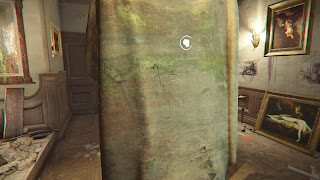
....do I actually want to see under the tarp...
A creation of Bloober Team SA, published by Aspyr and released on February 15th, 2016, Layers of Fear tells the story of an artist lost within the daedalus of his own mind. This perfectionist painter, in his search for inspiration in making his masterpiece, encounters scraps and scenes telling his story, what led to his predicament.

This is an environmental narrative title, so gameplay is fairly minimal; aside from walking around and seeing things happen around the character, you can often pick up items to observe them in more detail, interact with items you find (opening drawers, but also playing music boxes, etc.), and pick up papers to read them. And, as you explore, the details get clearer, although never enough to get a definitive answer as to what’s going on, leaving a lot to interpretation.

Okay. Before I turned my back, I swear this
painting was a peaceful scene in a prairie.
The game begins on a stormy evening, as the painter, in first-person view, explores his house that contains more booze than anything else of sustenance. He is being reminded of his current work, which has gone down the drain; among other things, he illustrated a version of Little Red Riding Hood… and his pictures turned to unsettling gore. Geez, was he making the art for the Brothers Grimm version? He seems unable to obtain a satisfying result with his newest work of art, which waits in the office, covered by a tarp. One look at it, and everything changes.

He steps out of his office and into a hall that wasn’t there before, to a room that also didn’t exist a minute ago. A lot of effects in this game utilize the technique of "behind the black", meaning that they happen outside of the first-person camera's field of vision while your attention is elsewhere. Another common trick is to disorient the player by changing where doors lead, as another example.

Or the clean room you left through a mirror
reveals itself to be completely thrashed.

As you approach the painting of a dog, the
happy barking stops... and is replaced by whines
and the crackling of a fire...
It’s unclear if all this is hallucinations fueled by the artist’s own mental issues or if there are genuine supernatural forces at play. And through this, we learn about the painter’s wife, her accident and passing, and the daughter he had with her. In the painter’s mental state spiraling out of control, paintings become Hellish. Rooms are clean one second and thrashed the next. Things move on their own as if they were haunted. And something seems to be patrolling the impossible halls of this ever-changing place… Will the painter ever complete his magnum opus?

Meh, they don't even have Dark Side of the
Moon in that household.

This is either gonna turn the picture into that of
a monster once my back is turned, or it will
do something else... or nothing and I am just
getting paranoid...
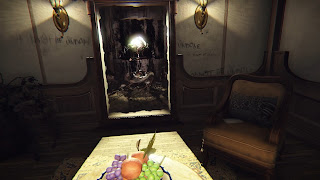
A genuine love for art can be felt through this game; beyond the set-up of the story, there are plenty of nods to classical art, especially the works of several other painters that pop up in the décor. The scares cannot actually hurt the player character, there is no life bar or Game Over screen, but they're still very effective nonetheless. Imagine: You open a door into a dead end. No door in front of you, no door either side. Turn around... The door you came in from has also disappeared. Another example: Look at a painting of a gentleman. Move to look at another painting. A windy whoosh later, the first painting now depicts a monster, the paint bleeding out of the frame. There are so many more examples, I cannot list them, but believe me – it’s effective.

Combine that with effective sound and lighting work, and you’ve got a state of constant disorientation. The changes are like the world pulling you deeper into that insanity, whether you want to or not. And since these effects rely on camera tricks, I can’t properly show them with still images.

Geez, I hope I won't have to clean that up.

WHAT THE FLYING FUCK-
Of all the freaky imagery in the game, who
would think the child's bedroom would house
the freakiest of the lot?
The environmental narrative means that there isn’t much to the gameplay, but each chapter tends to contain a basic puzzle to solve – in one, you work a gramophone; in another, you find the missing pieces of a checker game; in another, you wind up the daughter’s music box. Don't be fooled; that last one is the creepiest of the lot. While there is some voice acting whenever you reach a plot-relevant object, detailing more of the Artist’s life, a lot of it is also delivered through the objects you inspect and the scenes put in front of you. A highly effective sequence involves the Daughter’s drawings on the walls evolving to show her growing disillusionment towards her dad, as an example. Finally, there’s a collection side-quest that involves finding mementos of the family, and there are three different endings to the story. In short, the Painter clinging on to his past keeps his mind a little saner.

A genuinely fantastic game, and one that ranks among the best visual experiences I’ve had all year. A definite recommendation. Look this game up, it’s worth it. You might also enjoy the game’s DLC, Inheritance, which takes place a few decades later and features the Daughter. It also has special events around Halloween. Layers of Fear is available on Steam for 21.99$.

October 23, 2021

Quick Review: The Hat Man: Shadow Ward


Something’s gone wrong in this asylum.

Well this looks pretty norm-
A creation of Game Mechanics LLC released on June 10th, 2016, The Hat Man: Shadow Ward is a first-person horror/exploration game about a parent searching for their daughter at the local insane asylum where she had been sent. Things quickly descent into horror as the parent (whose gender you select at the start of the game) stumbles on their child’s journal, which comes to life, explodes, and spreads its pages across the facility. At the same time, said facility turns into a decrepit version of itself, with hardly a trace of light around.

....Okay. Yeah.

What’s worse, the pages the parent finds while exploring this shadow world version of the facility indicate that there’s a very real, very demonic presence roaming its halls. The Hat Man is on the prowl. Can this parent rescue their child without coming face-to-face with that wannabe Slenderman?

Why are all of these decrepit buildings so dark...
Right. No electricity. Silly me.
The gameplay here is very basic; move around with WASD, use the mouse to control the camera, and click to open doors and pick up items. You can switch between items you find with the numpad and use them to progress; as an example, very early on, you get an axe, and use it to break a door, which leads to the rest of the psychiatric ward. Most of the time, though, you’ll find the pages of the daughter’s journal; 23 pages total. They’re tied to progression in the game, so new areas are unlocked when you gather enough. Also of note, louder music will resonate whenever you’re in a room with a page.

...what? You've never seen a skeleton
taking an oil bath? You gotta get out more.
You kind of need that auditory clue, as there is no map. The ward is procedurally-generated on each playthrough, which means that you can’t even rely on your memory to remember a “path” you’ve taken before. You acquire a flashlight early on, which you can shine on darkness monsters to make them disappear… Oh great, I’m having déjà vu. When the flashlight falters and the sound of heartbeat gets stronger, this means that the Hat Man is coming close. Coming into contact with it is an instant Game Over, forcing you to start over. Only one solution: Move, constantly, and pick up whatever you find on the way. You’ll always pick up the pages in the same order, so it’s not like you can “miss” one (and worst case scenario, if you “miss” one, since progress is tied to the pages you collect, you’ll just keep going through the procedurally-generated maze until you’ve picked up more pages).

Oh no. I died. ...that's it, really?
This doesn't even spook.
It’s… very forgettable. This game does ambiance fairly well and doesn’t shy from showing creepy things, but ends up feeling very repetitive since most of the hallways and rooms look so alike. Sure, there’s a new detail here or there, like a boiler or a splash of blood on the floor, but they don’t help make any of the rooms in the main part of the game feel different. The change from a normal psychiatric ward into a hellhole is sudden and inexplicable.

I don’t recall seeing dark ghosts in the maze of rooms; only in the starting room where the place becomes ugly. What’s even the point of having them, if they don’t appear anywhere else? Admittedly, the concept of being chased and, therefore, always having to move, is pretty interesting, but the concept is kept to its bare minimum, with hardly anything original to do with it. Last but not least, the voice acting for the journal pages is subpar, and while you can choose between playing the daughter’s father or mother, that option actually makes no difference whatsoever in gameplay.

Nope, no difference.

You can skip that one, definitely. But if you still want to try it, The Hat Man: Shadow Ward is usually sold for 9.99$ on Steam.