Watch me on Twitch!

Streaming on Twitch whenever I can. (Subscribe to my channel to get notifications!)

March 25, 2016

Kirby's Dream Land 2


It was a nice day in Dream Land… UNTIL THE NIGHTMARES CAME!

Oh wait, I think I got this wrong. It was a nice day in the Rainbow Islands… UNTIL THE NIGHTMARES CAME!

No, wait, not quite it yet. It was a nice day in the Rainbow Islands… UNTIL KING DEDEDE SHOWED UP!

Um… No, that still doesn’t sound right. You know what? I think I’ll be better off explaining the game. Kirby’s Dream Land 2 is the third overall platform game in the Kirby series. Released on the Game Boy like Kirby’s Dream Land, this one pushes the limits of what could be achieved at the time with the portable console. Not only does it feature Kirby’s copy abilities from Kirby’s Adventure (a limited number of them, only seven), it’s also much longer (a little over 30 levels) and features a new gameplay mechanic: the Animal Friends.

Yep! Unhappy with giving us everything we wanted, the folks at HAL Laboratory give us even more! You see, when he defeats a mid-boss, Kirby frees from a bag one of four animal friends. There’s Rick the hamster, who’s great on land; Coo the owl, for all you people who have a strong urge to fly but nowhere to fly to; Kine, who sucks on land but is excellent underwater, which shouldn’t be a surprise considering it’s a sunfish; and Gooey, who appears only in a bag if you already have the animal friend who’s supposed to be in that bag. The first three are equipped to Kirby when he goes to them after freeing them; they have their own life bar, thus they provide six additional health points should you use either of them. They also put their own spin on Kirby’s seven abilities, resulting in no less than 28 different possibilities. Gooey is a special case, he refills one point of Kirby’s health when he appears in a bag. And he does it with a kiss. Oh yeah, Gooey’s a real ball of concentrated love. He doesn’t look the part, but that’s what he is.


March 21, 2016

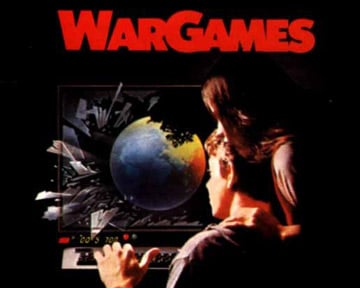
VGFlicks: War Games: The Dead Code (Part 2)

Ready to jump into the review of this movie again? If not, go read Part 1! Considering the crazy amount of explanation there is to do in this film, I prefer not to waste your time with a long intro. Let’s go!

A long time ago, two astronauts tried the same trick
to escape the listening ears of a machine. It failed there
as well.
Two agents (played by Trevor Hayes and Claudia Ferri) monitoring RIPLEY at Homeland Security meet in a car outside to discuss the affair. Agent Aaron Scott explains that RIPLEY has really been going overboard. Due to the tenuous links between Will and the terrorist group the money used in the Dead Code game came from, the machine will keep on looking for connections, up to the six degrees of separations; in layman’s terms, you might know it better as the Six Degrees of Kevin Bacon. It’s the theory saying that, if you took into account every person you met (or shook hands with) in your life, and then all the people each of these people met (or shook hands with), and continued this way, it will rarely take more than 6 such “connections” to be linked to anyone else in the world. RIPLEY is currently doing this to find an explanation for the Will Farmer case, which may lead it to incriminate most of the entire global population if it continues. Oh, by the way, RIPLEY watches them and reads their lips again… and is willing to manipulate road signals to get them out of its way… because yes, it can fucking do that, as it proves in a later scene, which leads to one agent getting hit by a car when the traffic lights suddenly change at an intersection…

Ah yes, those cold Canadian winters...
Professor Stephen Falken drives Will Farmer and Annie D’Mateo to a factory in a recluse sector, and on the way they reflect on the situation. Falken explains that he was part of RIPLEY’s design team, he was considered too threatening; hence why he hides. However, he was also diagnosed with pancreatic cancer, adding weight to why he’d kill himself (or fake such, in this case), and suffers from the disease. Will says that he lost his father at a young age, that he died after catching some local illness in a foreign country. Falken lays down the real facts: Will’s father worked for the American military and had been sent to Bosnia to help develop bioweapons… after which they got rid of him, using those same diseases they were preparing to throw en masse during the next armed conflict; and his death was disguised under a cover story for his family. These family relations also explain why RIPLEY ended up having such a freak-out…

Gosh, this thing belongs in a museum.
Soon the three of them reach a mostly abandoned station, where they are greeted by an old Russian guy. In there, they find the old War Operator Plan Response computer (WOPR, or JOSHUA, whichever you prefer). Falken inserts a card in the machine and types the backdoor password (Joshua), which causes the old machine to suddenly become a lot more efficient than it was. It even replies to Falken’s written lines with its own unique lines and its very own voice. Like an ancestor to Chatbots everywhere.

At Homeland Security, Hassert states that bioweapon prototypes have been found in the terrorist cell in Damascus (the one Will and *sigh* Dennis took money from) corresponding with the chemical samples found in the Farmers’ household, and that there might well be a dormant terrorist cell in Philadelphia. RIPLEY, listening in, decides to raise the threat alerts to a maximum and cuts off all the power in Philadelphia, with a countdown towards “decontamination” starting at 12 hours. Holy shit, RIPLEY is planning to nuke the goddamn city!

It's a gaming overload!!!
Since JOSHUA was in part made to work in tandem with RIPLEY, this means it can infiltrate its systems. Falken commands JOSHUA to “play games” with RIPLEY, which makes JOSHUA overload RIPLEY with Tic-Tac-Toe, checkers, go and chess matches, enough to slow it down, which brings back some power to Philadelphia…. But RIPLEY reboots itself to get rid of the games, and then launches a warhead towards the station where WOPR is located. The old machine barely has time to warn Falken, Will, Annie and the Russian guy. Falken stays behind and does a few things on WOPR as Will, Annie and the Russian guy get out in a hurry, merely seconds before the warhead falls and destroys the station. That’s also when the Special Forces arrive to arrest Will and Annie, and bring them to Homeland Security. At a little under an hour from “decontamination”.

Well, we didn't get a Philadelphia-shattering kaboom, but we did get a
Falken-shattering kaboom. ...Oh WOW, that was NASTY from me.

Brought to a room near the main control center of RIPLEY, Will and Annie (who’ve been given a laptop) devise a plan and contact Dennis to help them. They’ll be launching a DDoS attack on the machine’s servers, to slow RIPLEY down considerably. You know, this might be one of the first times in fiction that they portray such a technique. And at least, this time around, it’s used against a real threat. (Plus, for once, Dennis does something useful, it was about time…) And it works, as RIPLEY drops some of her control over Philadelphia as more and more people connect themselves to RIPLEY’s game. But she reboots again to negate most of the effects of the DDoS attack. However, Will accesses JOSHUA, which has been sent by Falken through e-mail. JOSHUA’s methods are still insufficient, though, so they convince the agents of Homeland Security to boost the prize rewards for RIPLEY’s game from 25,000$ to 100 million and advertise it everywhere to cause maximum traffic. After all, if there’s one thing we can count on in this world, it’s greedy people attempting to win it big with minimal effort, right?

In the background: All the player accounts opening in the hopes of winning
the promised 100 million $. In the foreground: An old Colm Feore who's
playing his role far too seriously for such a silly script.

So RIPLEY absolutely had to wish to self-destruct?
Sigh, those damned machines sometimes...
So illogical!
Feeling threatened, RIPLEY redirects the mission towards the Homeland Security headquarters, in Washington D.C. Annie explains that there’s a branch of chess masters playing “suicide chess”, where the point is to lose by having the opponent take all your pieces before you take theirs. Will explains this concept to JOSHUA and makes the program play this with RIPLEY, in a “Russian roulette” kind of way. With only 13 minutes at the countdown, JOSHUA begins playing with RIPLEY, each time causing a “loss” by showing that the launch of a single nuclear warhead would inevitably result in a Third World War, which is exactly what RIPLEY was programmed to prevent. Every scenario ends with the ominous message “Total annihilation”. The problem with this plan is that these simulations are meant to lead to actual attacks, with 1/6th of the nuclear warheads in America being currently ready for launch, and were they to find an active warhead RIPLEY could launch it.

You know you've fallen low if you're desperate for a
machine to get a clue...
And as luck would have it, a simulation weapon turns out available, heading for Washington D.C. Goddammit, I should have never watched this film! Is my inherent bad luck, my jinx, traveling across media now and tipping the odds against protagonists by the mere fact that I’m watching them? When will this bad luck ever leave me??? Thankfully, by this point RIPLEY has learned that there is no point in a game where victory means defeat, and stops responding, canceling the attack. When JOSHUA asks it if they’re still playing, RIPLEY responds that “the only winning move is not to play”. Huh, I feel the same about Uno, Monopoly, Mario Party 2 and Mario Kart DS. Hurray, catastrophe avoided!

Well... in this ending's defense, they're two computer
nerds. They know they're compatible.
After the celebrations, Will asks JOSHUA if he really would have launched the warhead, since it got so close to doing so. JOSHUA replies that he would have as the humans are finished… before adding that it was a joke. You know, I’m not sure if I want my AI with a sense of humor after this. I mean, it’s already bad enough when they take everything seriously, what will it be like when we snark at them and they snark back? Whatever. All’s well that ends well, Will is now dating Annie (Oh great, does that mean he “earned” her? Urgh.), roll credits.

Bleh. Can’t say I outright hated it, but it’s still a rather mediocre film. Then again, what else was I to expect from a direct-to-DVD film?

I mean, I could say I’m happy that the film is set, for half of its duration, in Quebec, and that it features mostly Canadian actors. There’s also that, for all the flak I could give it, the movie at least treats hacking with more serious than most films, in that it uses real techniques that take time, and the machines (especially RIPLEY) show exactly what kind of dangers await those who put too much faith in a learning AI… not that we needed another reminder anyway. There is not a danger of a third World War (not until the final “duel” between JOSHUA and RIPLEY, anyway), but this whole mess ends up causing different kinds of problems to the American infrastructure.

However, despite whatever little praise I could give, the film gets taken down by a number of issues. The passable acting, the terrible CGI special effects and the nonsensical story. I made jokes about it in Part 1, there are so many coincidences in this plot that it’s pretty much impossible to believe. What’s worse, for this plot to work, it needs those coincidences. This story is just a mess, and it’s so blatantly obvious which way it’s going to go that you’ll see it coming from miles away. Stephen Falken returning? Seen it. JOSHUA appearing? Seen it. RIPLEY turning on its masters? Totally unexpected! Oh, who am I kidding… SEEN IT! Annie bringing up a variant of chess to help defeat RIPLEY? I mean, that scene at the chess club had to have a purpose, right? Need I go on?

For a movie that tries to depict neither side as a villain, the agents of the U.S. Department of Homeland Security sure do a lot of dangerous things, like relying on RIPLEY (programming her with defects that make her a threat to anyone, including themselves), or chasing after Will and Annie and almost running them over. Their plan, as a whole, is idiotic. Using an online video game to detect potential instances of domestic terrorism? Gee, what can go wrong with that plan? The only way to play that stupid Dead Code game is to bet money, so for one, those potential “terrorists” who don’t have money to waste on online games won’t go detected. And what about totally innocent gamers who somehow reach that game, beat it (after multiple attempts) and get falsely accused of terrorism? No video game can be used to properly judge if someone is dangerous, nor can video games cause violence in real life. One’s attitude in a game can and will differ greatly from what they are in real life, especially when the potential for cruelty in-game is at a maximum.

Never forget this.
And I’m forgetting many other instances. Oh, and of course, should I mention that Will’s friend Dennis now ranks on my personal Top 15 of the most annoying characters I have ever had the (dis)honor to see on-screen? Sure, by the end he helps in taking down RIPLEY, but it’s too little too late. He’s not all bad, he does have a few good moments here and there, but his awful moments are far more frequent.

In the end, War Games: The Dead Code is a poor movie, a sequel no one asked to a movie that was never meant to be a franchise. Don’t bother with it. It’s not entirely terrible, but it’s definitely not worth actively seeking it out. Hell, I only paid my copy of it 3 dollars, and that’s enough. I don’t think I’m going to watch it again. The worst part is that MGM thought, for a moment, that there could be more direct-to-DVD films based around War Games, but thankfully this plan doesn’t seem to have carried through. Guess they didn’t make enough money.

You know what? Go play chess instead. Though, I’ve also seen my fair share of crazy chess players…

Next week? Oh, time to continue looking at the Kirby games in the Dream Collection, with Kirby’s Dream Land 2!

March 18, 2016

VGFlicks: War Games: The Dead Code (Part 1)


A little bit of history about video game movies. It’s hard to believe for the millenials, but there was a time where video games were not a widespread fact of media. Anyone who lived in the 80s and early 90s know what I’m talking about. This was the golden age of arcades, the machines were large and sucked out your cash as long as you were ready to shill out another quarter or a buck to try and beat your own high score. Oh yeah, that was also a time where scores mattered. Also, home computers were a rare thing, and those things were big too. Obviously, this was not a time where there was a single video game popular enough to make a film. And yet, 1983 saw the release of the first movie with video games – or, well, computer games, but you get the picture – as the central point of the story: War Games. The Famicom wasn’t even out in stores! War Games came out in May, the Famicom in July!

War Games was the story of a brilliant teenager (played by Matthew Broderick – still accumulating roles despite our hopes that he had stopped in the early 2000s) using multiple hacking techniques existing at the time, until he finds his way to a simulation game… or so he thinks, as said simulation game reveals itself to be an actual military program designed to launch very real nuclear weapons, and the teenager’s mindless toying with the program takes the entire world closer by the minute to World War Three. That’s kind of a big deal.

I haven’t had the honor to see the original War Games movie yet, but until I do, here’s a fun fact for you: In 2008, thus 25 years later, they made a sequel to this. The new film, called War Games: Virtual Boogaloo-er, I mean, War Games: The Dead Code – can be seen as a sequel nobody really asked for. But we got it, and it deals with computer games, so I had to check it out. They managed not to make it a box-office bomb… by not releasing it in theaters, doing a direct-to-DVD release instead. It was also filmed in Montreal, so there’s that. Hey, who knows, this could be good snark material. Let’s plunge into War Games: The Dead Code, and see if it was worth reviving this film with a sequel.


March 16, 2016

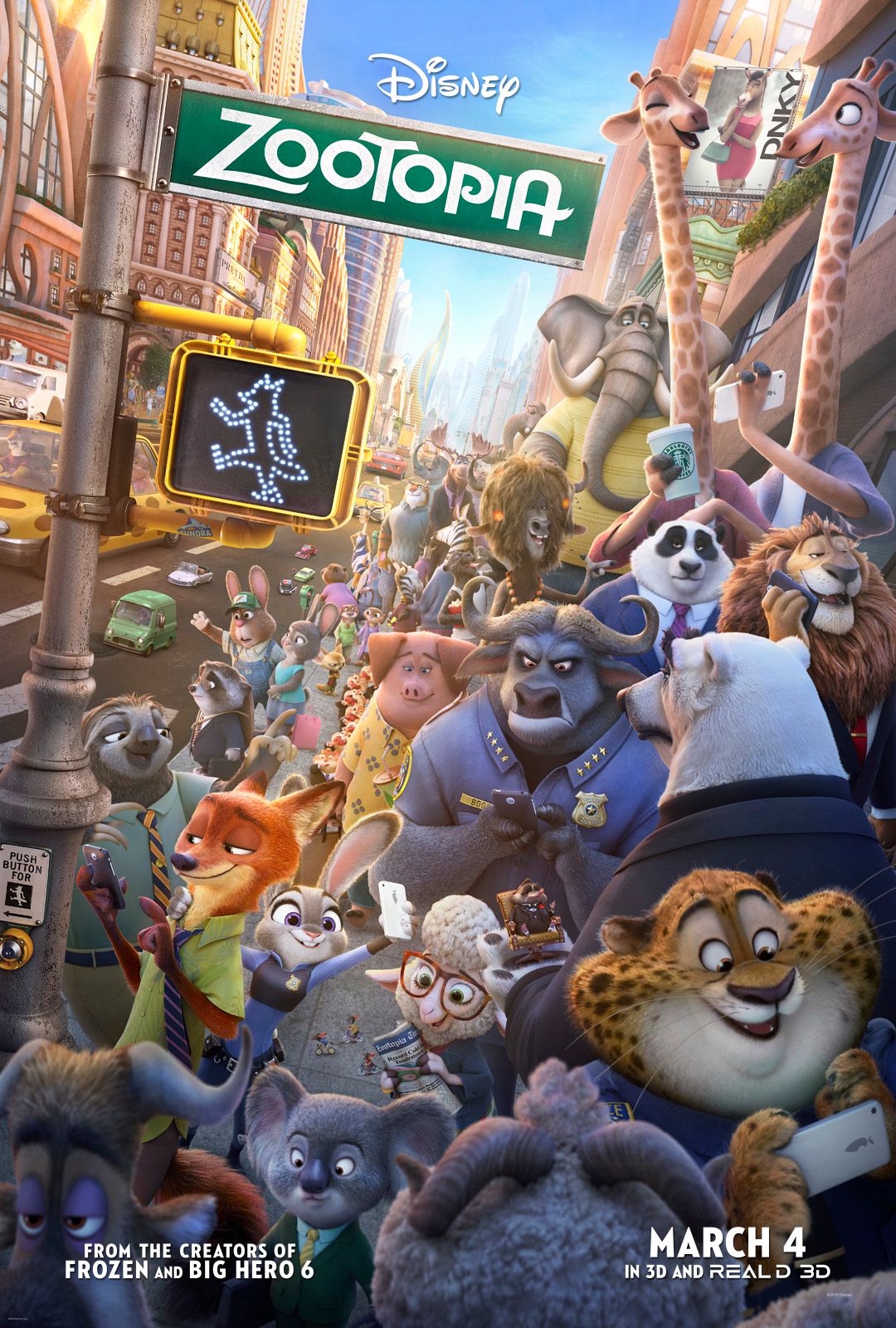
Movie Week: Zootopia

So many characters, so much detail...
Is that a carrot on this guy's iPhone?
Disney’s 55th animated film and one of the more political films for children they’ve released in recent years… despite a cast made up only of mammalian animals. I’ll try to avoid revealing spoilers as much as I can.

Young rabbit Judy Hopps dreams of leaving the family business and become a cop in the big city, going against what people expect her to be; and become a cop, she does, after working harder than everyone else at the police academy. She finds a place at the Zootopia Police Department thanks to a social program instated by the Mayor that promotes diversity at the police department. There, on her first day the gruff Chief Bogo assigns her the task of being a meter maid. Now, some people would see the logic behind a choice like this; Judy is a new cop who doesn’t know the city’s layout, and this would be a chance for her to familiarize herself with this new environment… but Judy doesn’t see it that way.

Still, she applies herself to this new task, and soon sees a fox entering an ice cream parlor for elephants with a kid. Now, I must point out that Judy has grown, under her parents, with preconceived ideas about foxes (and an encounter with a fox bully didn’t help matters), but decides to give the fox a chance… well, until she finds out he was there to buy a large popsicle, melt it, and sell it as smaller popsicles as part of a scam. And when she confronts him about it, he calls her inferior compared to all the other animal species who are better suited to be cops. Judy also proves to be quite reckless when she chases a runaway crook in Little Rodentia, where she’s bigger than everyone else and risks stepping on a citizen at any moment.

This makes Chief Bogo not like her very much as you can guess, and he threatens to fire Judy. That’s when an otter lady comes to the police station to report the disappearance of her husband; Judy hurriedly takes the case – again, against her chief’s orders. And before Bogo can fire her, the mayor’s assistant, Dawn Bellwether (a sheep), congratulates her for taking the case. Bogo, obviously not happy with this situation (and forced to follow Mayor Leodore Lionheart’s orders to promote diversity), reluctantly gives Judy the case and gives her a 48-hour ultimatum. What little information Judy can gather brings her back to the fox she met the day before: Nick P. Wilde, who happens to have sold a popsicle to Mr. Otterton.

She manages to trick him into helping her, but Nick makes sure to waste as much of her time as possible (which includes passing by the DMV to find a car with a plate number, which results in that scene with the sloths, the one you have to remember because of the trailer). And thus begins a quest where Judy and Nick become unlikely allies in an investigation that reveals a threat to the mostly peaceful life in Zootopia and the social climate within it.

Honestly, this is where I have to stop. I won’t spoil more of the plot itself, though I’ll need to spoil certain elements of it (mostly the background) for the following analysis, so if you don’t want to know certain very important details, stop reading right away.

--------------

The world set up in this movie seems bright and colorful, with all the animals, both predator and prey, living in the same city. Sure, each species has kept a few of the traits we expect them to have (Judy is really quick and agile, Nick is cunning), but the problem does not lie in the fact that all the mammalian species live together. All the drama of the movie lies in the preconceived ideas some of the citizens share about others. Expecting certain animal species to act the way we imagine them to, either due to their species or due to the way they look. Each species is expected to fill a certain role. “Rabbits can’t be cops”, that’s the kind of thinking that Judy goes against. “All foxes are nasty con men”, that’s the way Nick goes (mostly because that’s what is expected of him by many other members of this society).

The story involves predator animals being found feral for an unknown reason, and this sparks a social conflict in Zootopia where the prey animals, who make up about 90% of the population (according to Dawn Bellwether), start getting fearful about the remaining 10% and shunning them for what they seem to be, not for what they actually are. You heard right: The villain of Zootopia, whoever it might be, is attempting to provoke a large-scale racial war.

The moral of the film, as a whole, is that “everyone’s a little bit racist” (cue the Avenue Q song), even those who are already oppressed. Everyone has ideas about others, beliefs about others that have no basis outside of appearance and certain stereotypes that just don’t want to die. Nick strongly believes against rabbits in the police force, while Judy has gained from her parents the mindset that foxes cannot be trusted (and even profiles him, like some cops in real life do with black people). Yes, everyone has that part of racism, sexism, that part of –isms basically, and one way towards making the world a better place is to get rid of this dark place in each of us. In a more idealistic story like Zootopia, it may be easier to do, but in real life? People don’t change that quickly, sadly.

The other moral, “look beyond appearances”, permeates the entirety of the movie, it’s not tacked on like many lazy films for kids do. Every character is shown to have a side that clashes with what you’d expect of them. I already explained about Judy’s deep-rooted prejudice against foxes; meanwhile, Nick has had a pretty awful childhood and only goes with the “con man” life because that’s what he’s expected to be. Chief Bogo, for how imposing and threatening he looks, is just doing his job (and Judy is acting impulsively and not following his orders, even though she just started so he's right to berate her); he’s also a fan of pop stars, and after Judy proves her worth, he treats her with much more respect. The mayor, Leodore Lionheart, is a lion with a large but reassuring, warm presence but reveals himself to be kind of a jerk. Pop idol Gazelle is socially involved and takes a stand when the racial tensions arise, in defense of predator animals (she has four tigers as her backup dancers, this should be a tipoff that she trusts them). The mob boss of the Tundra region, Mr. Big, is ruthless until he finds out his daughter was saved by Judy earlier in the film, after which he treats Judy and even Nick (whom he previously hated) like friends. Flash the sloth at the DMV shows a hidden side of himself later... Heck, even Judy’s parents grow out of their prejudice against foxes when we see them again later on.

This movie is just incredible. The amount of detail put not only in the plot, but also in every character, every environment, every scene, is beyond words. The characters are likable and introduced very well, not only in how we’d perceive them to be but also in how they actually are beyond race or appearance. The result is a complex fable about racism, bigotry and acceptance, which are pretty big themes for Disney to tackle in one of their films. It was a great risk, and they hit all the right notes. The funny scenes are REALLY funny, there are many awesome action scenes, and the drama is very well-done. Even the police investigation aspect is treated mostly with serious, with Judy (and then Nick) following every trail of information they can find, then going up the clues in order to solve the mystery. I would say that the reveal of the real villain of the story doesn’t come off as much as a surprise since Disney has done a similar reveal in three of their preceding films before this one (Wreck-It Ralph, Frozen and Big Hero 6), but that’s really a minor complaint that doesn’t take away much from the film.

My only fear is that the movie’s powerful message, which is made obvious in its duration and in how it’s the central point of the entire drama, will go over the heads of those who would learn from it (that is, racists and bigots in general).

Seriously though, I don’t think I can praise this movie enough. I consider this to be one of the best animated films I’ve seen, period. If you haven’t seen it, go see it. It’s worth paying a theater ticket for.

March 15, 2016

Movie Week: The Little Prince


Will not be released in the United States (the original release date, March 18th, has been taken off). God damn it. Therefore, I don’t think I’ll feel any shame in revealing spoilers, since there doesn’t seem to be any release date. I’ll still try not to make this review too long, though.

We follow the story of a young girl whose mother is, without a doubt, the worst case of helicopter parents I have ever seen, setting up her daughter for scholar success and nothing else. Social life? Which kid needs that? Is it really that important? They move closer to the school the mother desperately wants her daughter to get in, and it turns out they live right next the aviator of the story, now a very old man. The young girl actually meets him on her first days in her new place, and soon starts visiting him behind her mother’s back. The Aviator tells her his encounter with the Little Prince.

This movie gets very creative in its framing device; the main story with the young girl, her mother and the Aviator is shown in CGI, while the Aviator’s story is shown with stop-motion animation. The story from the book is re-told through vignettes, whether it’s the Little Prince growing the rose on Asteroid B612, visiting the other asteroids, then landing on Earth where he befriends a fox. He later meets the Aviator, who crashed in a desert, and they spend time together as the Aviator repairs his plane and the Little Prince tells his life story.

Meanwhile, the young girl has nearly stopped following the strict schedule set up by her mother, and visits the Aviator every day, and hears his story as he repairs his plane. He even offers her a fox plushie. After the Aviator makes a mistake, the mother finds out about this friendship and enforces her schedule. As if that wasn’t enough, the young girl and the Aviator end up having a major disagreement near the end of the Little Prince story and she breaks their friendship. Sometime later, the Aviator is hospitalized. Thinking he needs the help from the Little Prince, one night the young girl climbs aboard the plane and flies off, with the fox plush as her co-pilot, in space in search of the Little Prince.

Everything from that point on is original material that meshes the two elements of the framing device, and the young girl’s quest to find the Little Prince takes her to an asteroid that is all a giant city where adults work, and without a single child in sight. And from there, she starts looking around… and honestly, I should just stop there.

The movie does try to recapture the spirit of the original book, at least in the stop-motion scenes. And those are beautiful. The CGI scenes with the mother are meant to emphasize the joyless life many adults appear to live and how they often raise children into having the same life as them, that is, a life where all that counts is work and nothing else. The Aviator is meant to represent those who grow up with still this kind of childish joy and charm that adults often manage to keep within them as they grow up. As he says, “growing up is not the problem; forgetting is”. A good morale if there ever was one. The contrast between the young girl’s house and the Aviator’s is also very interesting. Also of note, no character in the entire movie has a given name, as you may have noticed so far; the young girl, the mother, the aviator and any other character introduced in the film’s runtime. The third act ties up most encounters in the original story of The Little Prince into a cohesive story, though how well they succeeded, and how well they kept the spirit of the book, is up to the viewer. Thankfully, the animation is absolutely marvelous, from beginning to end, a real treat to see.

I personally enjoyed the third act, though you might not. You should try to find this movie and watch it, since you won’t be able to see it in theaters in the foreseeable future.