Watch me on Twitch!

Streaming on Twitch whenever I can. (Subscribe to my channel to get notifications!)

April 5, 2024

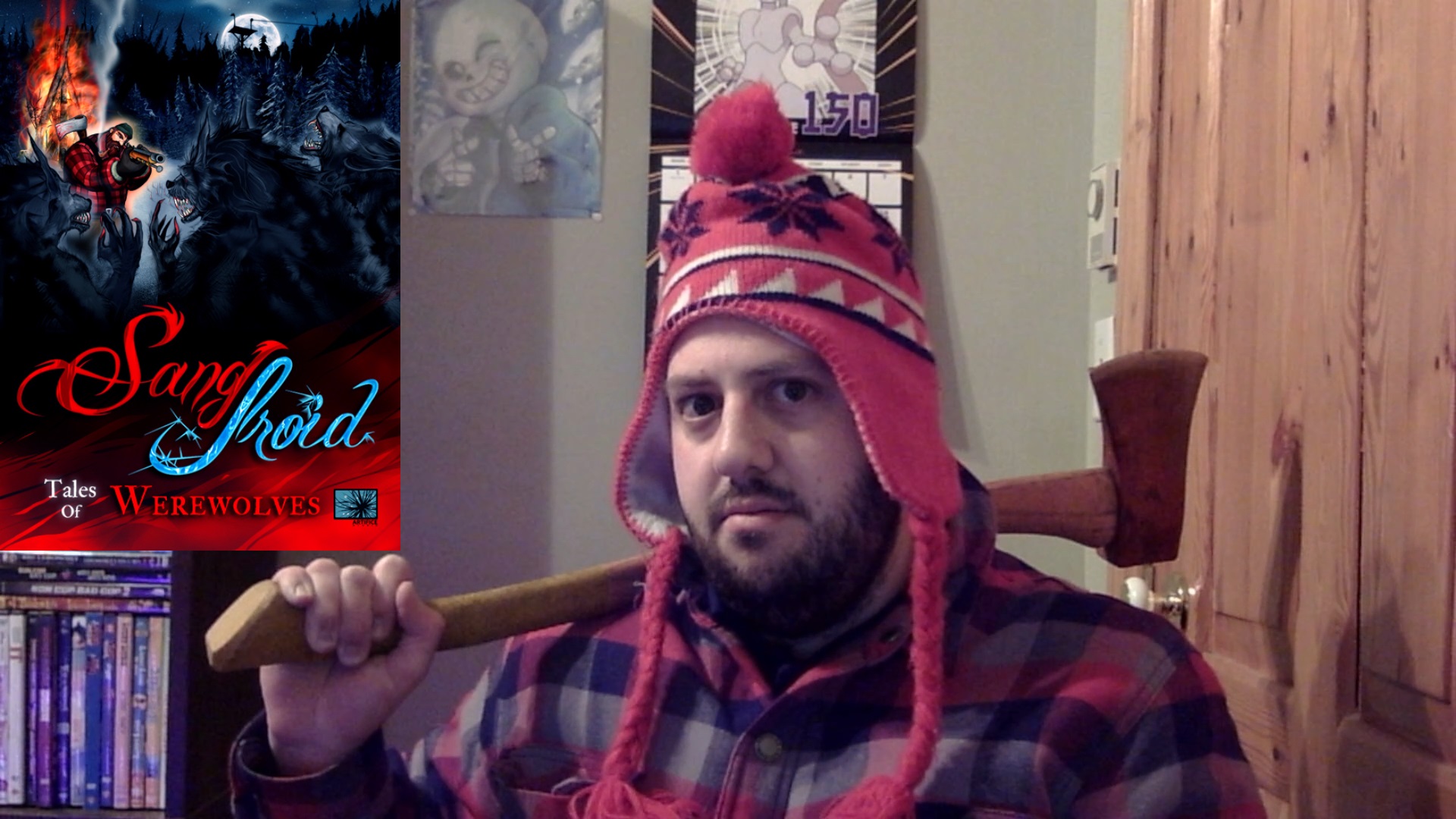
Sang-Froid: Tales of Werewolves


I don’t get to discuss my culture as much as I’d like to on this blog. The province of Quebec is home to many notable studios, large and indie. I make a point to mention it when I know a game I’m reviewing was Made In Quebec. But even then, very few games show our folklore.

Plaid shirts, beards, axes and determination are a
mandatory part of the package.
I know we don’t have the luster of the more famous mythologies out there, but you’ve gotta give us a chance. Only in this part of the world will you see stories of Christian lumberjacks defending their cabin and sister, in the dead of winter, from an army of werewolves conjured by the Devil himself. That’s metal. We Canadians get stereotyped as nice guys. You see what our ancestors had to deal with? We channel our aggressivity where it matters; hockey, and kicking Satan's ass.

Sang-Froid: Tales of Werewolves was developed by Artifice Studio and released on April 5th, 2013. Its story was co-written by Quebec author Bryan Perro, known for the Amos Daragon and Wariwulf book series and a major advocate of our folkloric tales for the world at large. The game is now free on Steam and GOG, though I reecall purchasing it several years ago.

Don’t expect us to put on the kiddie gloves. We’re showing our mythology, warts and all. Pack your winter gear, there’s gonna be a lot of snow. Silver bullets and holy water might help, too.


Sang Froid, lit. Cold Blood

In the introduction, we witness a man, Doctor Lamontagne, killed by wild beasts before he could find the refuge of the nearest cabin. When we begin playing, we choose one of the two Irish-Canadian O’Carroll brothers: Joseph (Jos) or Jacques (Jack). Jos, a big, burly guy, has more stamina and higher base attack, while Jacques is more lacking in both. Jos is the normal difficulty option, and Jacques, the high difficulty one.

Considering what we're up against...
I'm gonna go with the muscle.

March 29, 2024

For Honor


Ubisoft is no stranger to games dabbling in Alternate History, though they’re most famous for their use of it in the Assassin’s Creed franchise. Other franchises of theirs that utilize the concept, like Anno, go a little looser with it. No matter how much they play with historical events and time periods, there is an attempt at depicting details with as much accuracy as the setting and gameplay can allow. Today’s game is, as a result, a very bizarre beast because it’s going for insane historical accuracy while, at the exact same time, depicting something completely fantastical.

If knights and samurai fought at some point in our long
History, I'm sure it's never to the extent that they do here.
Developed by Ubisoft Montreal and released on February 14, 2017, For Honor’s genre is hard to pin down. At its core, it’s a third-person melee fighter, which sees you mowing down weak enemies and using strategy to take down stronger ones. Like a 3D beat’em-up with swords. While the game includes a single-player campaign, it puts a lot more focus on its multiplayer options. There, you can take part in fights as a member of one of the available factions, earn points for your group, and help conquer territories in this endless war.

For, yes, this game is about war. War never changes... Wait, wrong studio. But the spirit is the same. I’m not huge on multiplayer, but I’ll do my due diligence and discuss that part before focusing on the single-player campaign. I’d usually do this in the opposite order, but I’ll probably spend a lot more time on the campaign, so multiplayer first. Or, wait, no. First, I guess I’d better explain the setting.


Fighting Spirits

The base concept of this endless war is that multiple warrior races live next door to each other at the same time and, since that’s all they really know, try taking over each other’s territories. At launch, only three “clans” existed: The Legion (medieval knights), the Warborn (Vikings), and the Chosen (Samurai). Later updates add two new clans: The Wu Lin (based on Ancient Chinese warriors) first, then the Outlanders, travelers from other cultures, who don’t fit the other four and chose to team up against them.

There's probably an entire thesis to be written about every
bit of equipment worn by every member of every
character class. I shall not be the one who writes it.
An interesting aspect of these clans is that they all span several centuries of our world’s History, and it’s reflected in their various classes. And yet, at the same time, classes are about all as time-displaced as can get; an example would be the knights, who feature Centurions and Gladiators based off Ancient Rome fighting on the same side as multiple types of knights who existed anywhere from the twelfth to sixteenth centuries. The same goes for armors and weapons, as most if not all of them are inspired by very real equipment worn by each class, to say nothing of techniques and strategies co-existing despite having been invented several centuries apart. Anachronisms is the name of the game, not just within clans, but sometimes within a single character class. I’d probably need a few years of historical studies to understand everything that’s featured here and all the ways in which they shouldn’t make sense when put together.

These anachronisms fly by so easily because the setting is blatantly fantastic. Either way, you’ve at least got to hand that to Ubisoft Montreal, they put in the work.

March 22, 2024

Gaming Memories: Super Mario Bros. 2


Super Mario Bros. 2
Nintento Entertainment System
September 1988

Still to this day, what the American continent originally got as a sequel to the first Super Mario Bros. on the NES stands as one of the oddest entries in the franchise. It's not much of a secret that this game was made by taking another game, namely Yume Kōjō: Doki Doki Panic, and slapping Mario characters on it. Actually, I think it's the most-repeated "mind-blowing fact you don't know!!" (clickbait look intentional) in the history of gaming. The reason this was done was allegedly because the actual Super Mario Bros. 2 ("The Lost Levels"), which Japan got, looked identical to Super Mario Bros. 1, with the main difference being that its difficulty was through the roof.

Since it adapts a game with four playable characters, SMB2 marks the first time we can actually play as Princess Toadstool (who wouldn't become known as Peach in the English version of Mario games for a few more years) or as Toad. All four characters play a little differently, as well; Mario plays like usual, Luigi jumps a little higher, the Princess can float thanks to her dress, and Toad has greater strength so he picks items up faster, but his jump is abysmal as a tradeoff.

With its bizarre inception, you could think that this game struggles to fit with the remainder of the franchise, and... well, with its gameplay that involves uprooting plants and tossing things to attack, you'd be right. In this case, it's fairer to say that the Mario franchise retroactively accepted SMB2 (often referred to as Super Mario USA to differentiate it from Japan's The Lost Levels) into its canon. Mainly by transplanting some of the enemies into the larger franchise; Subcon, the game's dream world, is where we first met, among others, Bob-Ombs, Ninjis, Pokeys, Shy Guys, Snifits and Birdo, some of which reappeared as early as SMB3. However, its major bosses have remained divorced from the series, with fewer in-game references to Wart than you can count on one hand. (He does appear in other places of Nintendo canon however, with one notable appearance in The Legend of Zelda: Link's Awakening!)

This game's other major secret is also well-known; namely, that this game was Mario's dream. Beating Wart shows a quick cutscene of Mario sleeping, thinking up the events. Gives Wart's appearance in Link's Awakening an interesting double meaning. However, as far as I can remember, I don't recall ever actually getting to the end of this one. Blame it on the weird mechanics that felt too different from classic Mario fare, but when given the choice, I would usually go for SMB1 or 3 instead. Probably 3. It's been a while so I don't remember perfectly, but I think I never got past Fryguy, the fourth boss and the most annoying of them. Which doesn't mean it's a bad game; it's pretty good. Just not what I was looking for in a Mario game, I who also had access to Super Mario World, making it sit in its corner as the oddity it is.

I definitely played it a lot more than I played The Lost Levels, though! That one's a masochist's game.

March 11, 2024

Trauma Center: Second Opinion (Part 2)


Strain of the Week

I wondered where the names of the GUILTs
came from. Turns out, it's just the days of the
week in Greek. Kyriaki = Sunday,
Deftera = Monday, etc.

When we left off, Derek learned that his mentor, Greg Kasal from Hope Hospital, has been infected by a strain of GUILT, those new super-diseases created by medical terrorist group Delphi.

...Yeah, I just wrote that. What, were you expecting a video game about a surgeon to be normal? We already jumped the shark, it’s all downhill from here.

Dr. Greg is a far cry from the happy man we had
as our mentor. It is only fitting that he
becomes our final exam as a student...

Although the true form of Tetarti is shown in the
picture above, we actively participated to a
testing/research period beforehand, helping
make a cure for the strain.
Since the strain is new, the team at Caduceus doesn’t have a treatment for it. A serum is in the works, but they need more antigen. Several other weaker cases of the new strain, known as Tetarti, have popped up around town. Each one of them seems to be a slightly different virus, so we go around town operating on the people bearing these weaker strains and obtain no less three antigen variants. Victor, ever the smiler, finishes the serum, and then we operate on Dr. Kasal to remove the GUILT. This one comes as three creatures that move around the organ; one green, one yellow and one purple. You must inject each with the serum of its corresponding color, and you must do that before all three disappear at the same time. Their colors also go away after a bit, forcing you to remember which is which (or watch their trails of colored gas to figure it out).

Victor never cracks a damn smile, but he gets
shit done. That's all Caduceus asks for.
Kasal is saved, but this is only the beginning of trouble. Secretary of Health and Human Services Richard Anderson, who doubles as head of Caduceus, is giving a speech downtown when he suffers a cardiac arrest. Hospitalized, it's revealed to actually be another unknown variant of GUILT. Christ, there’s gonna be a hundred of those things by the end. Diseases: Gotta Catch ‘Em All! Since Caduceus does not have the cure for that one, Mr. Anderson courageously says he’ll be their guinea pig so they can study this new disease and counter it. Our first operation on the man is a series of experimentations with the aid of Victor; we don’t cure the secretary, but we have data and samples to work from.

There's the cuts, too. And the little things
this damn disease keeps spawning, as well.
Victor puts Derek through some tests to work on a cure for Pempti, the new disease. This leads to a new liquid, with limited efficacy; it only reveals the core of the virus, another little monster to kill, which the current solution can’t do. More experimentations follow until we have something that can beat Pempti. We operate on the secretary again and kill the disease, but the repeated surgeries have weakened him too much to survive. Before dying, he meets with Robert Hoffman, the director of Hope Hospital, and begs him to take over as head of Caduceus and to go back to performing surgeries. Hoffman had left the practice to focus on managerial duties following catastrophes caused by the use of his own Healing Touch. Hoffman agrees, determined to put an end to Delphi.

Good to see him come back to the practice.

March 8, 2024

Trauma Center: Second Opinion (Part 1)


Who needs gloves, anyway?
One of the indie games I’ve played for this blog that I keep a soft spot for is Surgeon Simulator. It’s exactly as wacky as it needs to be. Realism? Forget it, just free the old heart, shove the new one in there, and here we go, patient’s good as new. Patching ‘im back up? We’re way too good for that. What? Those organs left on the floor? Those weren’t important. Who cares about a spleen anyway? Alright, next up we put a new eye in this guy's socket-whooops! Lost it! Good thing we had that miniature 8-ball lying around!

Point being, Surgeon Sim is a lot of fun, but we don’t really need a story to go with the kooky procedures. No need for that sort of glazing while we operate on poor ol’ Bob on the table, in the hallways, in the back of an ambulance, or in a zero-G environment. But what if we had a story? Well, as it turns out, indie gaming came to this second. Before the funny surgery game on PC, there was a series of funny surgery games... on Nintendo consoles.

Developed by Atlus, the Trauma Center franchise was a series of five games released from 2005 to 2010. Today’s game, Trauma Center: Second Opinion, is the second game in the series, but it’s a remake for the Wii of the first game, Trauma Center: Under the Knife, originally on the Nintendo DS. The original touch screen gameplay had to be adapted to the new console’s motion controls. Second Opinion is also notable in that it was a launch title, released on November 19th, 2006 alongside the Wii.

This series combines the stress of performing operations with a story delivered visual novel-style. You know the medical drama genre, right? House, ER, Scrubs, “it’s never lupus”? Well, it’s not gonna help much. Trauma Center is to the medical field what Ace Attorney is to practicing law. I hope you weren’t expecting accuracy and realism, is what I’m saying. What can you expect instead? Oh, just wait...


Dr. Stiles

By the way, I took my screenshots from the Let's
Play on the channel ProZD Plays Games.
Check it out to see the full game!
This 2006 game takes place in the faraway future of... 2018. Technology, including in the medical field, has seen leaps and bounds. We meet our protagonist, Derek Stiles, an up-and-coming new surgeon at Hope Hospital. He is led through his first operations by Nurse Mary Fulton, Hope's surgical assistant, and the hospital's director Greg Kasal (who’ll take on a mentor role and take over if an operation is botched). Derek is quickly shown to be excellent under the pressure of the operating room (...as excellent as YOU can be, that is), but lacking in all other areas of the job. Bedside manners, post-op care, reading and filling the patient files, actually getting to the hospital on time... Jesus, that’s a disaster waiting to happen. We’re starting on the right foot!