Watch me on Twitch!

Streaming on Twitch whenever I can. (Subscribe to my channel to get notifications!)
Showing posts with label Roguelike. Show all posts

September 8, 2025

Quick Review: Recesses


You ever hear kids giving each other philosophy classes in the schoolyard? Nah, I usually just see them play children’s card games.

The start of an epic card game journey.
A creation of Sanjuny released on August 23rd, 2024, Recesses is a roguelite card game. Your character is a fifth grader, and your best friend Clair teaches you about this new awesome card game called Battaliens. Later, she goes missing, and everything points to this disappearance being linked to the game. You set out to investigate, challenging kids at recess in growing order of grade. One student per day, all week. Maybe, by Friday, you’ll have enough information to find Clair?

I should explain Battaliens, then; there's a lot.

Hey, you can even save up to 8 different decks! Good to
set up strategies against specific opponents.

-Battaliens are split into four types: Cute, Weird, Gross and Scary. Each type has one other type it's generally strong against, and a third it's generally weak against.
-Each Battalien has a value on the top right that counts as both its HP and attack power. When a round is played, both monsters attack at the same time, each deducting their attack from the other’s HP. A monster whose HP hits 0 as a result of battle gets sucked into a black hole, while a survivor returns to the shapeship (the deck) with its new, post-fight HP/attack.
All my remaining monsters have strengths and weaknesses.
Just hope you're lucky
-Most monsters have strengths and weaknesses, where their base attack/HP will be modified depending on the type of the creature they’re fighting. As an example, “Cute +1” means your card gains 1 HP/attack if it fights a cute creature. A monster doesn’t die if its HP reaches 0 from strengths/weaknesses/effects alone. (The cap for HP/attack is 9.) Most monsters also have a special ability that triggers at specific moments (at the start of a turn, when first played, when it wins a battle, or when it loses).
-Both players' “spaceships” can hold 8 cards. The player that sends all cards from the opponent’s spaceship to the black hole wins. (In Story Mode, a tie is considered a loss.)
-If both cards have effects that activate at the same time, a coin is tossed to figure out who goes first. Luck can screw you over here. You do not know which cards your opponent uses until they use them – which can make picking random targets a double-edged sword.

That’s the basics. You’ll figure it out as you play.

Beat that other kid up? Nah. When the core of the game is
about a competition (cards, monsters, etc.), I only desire to
punch those who deserve it. I call it the "Lysandre Rule".

The further in you go, the harder the enemies become. They
even have their own Egyptian God-level cards...
The story's format is a roguelite. Each day, you’ll battle another student. No matter the outcome of the duel, you get a booster pack with 8 extra cards, so you can build your “deck” from there. Opponents get tougher every day, so you’ll probably lose at some point – in which case, you start over on the next Monday. But! You later get access to tools that make the week more tolerable. The first is a friggin’ time machine (…don’t question it) that lets you skip to the day of the last opponent you’ve beaten. Which means that you’ll have to beat them again before accessing the next opponent, sure, but it helps. More stuff comes up over time. Perhaps more intriguing are this game’s bosses and their “Elder God” Battaliens…

I swear these fifth graders talk like university
philosophy students.
No, wait, even MORE intriguing is how all the opponents you beat have some spooky, borderline philosophical talk about life, the universe, and everything. Stuff no kids should be talking about, but apparently, there’s just something about Battaliens that opens their minds. Ehhhh, don’t question it.

The game started out with a lot of goodwill on my end; the concept was interesting, and the game's simple look hid its depth, which I discovered the longer I played. The story is engaging and the art style deliberately imitates the look of stuff drawn by elementary school kids. Even the difficulty feels fair for the first few opponents, but then the game takes a big swerve into Ultra Hard territory.

This opponent has TWO Elder Gods. And she's goddamn
unbeatable unless you literally cheese the battle by using
cards that specifically counter her big two. I HATED this fight.
You can hardly plan ahead due to the randomness aspect and the fact that even coin tosses can screw you over if you’re not lucky. Later opponents have downright unfair cards, and are so hard to beat they turn the game into an utter slog. Your only option is to tailor your spaceship to fight specifically what you know you’ll encounter (final opponents have randomized decks, aside from specific cards they always carry), and hope you'll be lucky with card interactions. For a game with so much strategy, that so much of it still boiled down to luck, and not enough to skill to my liking.

I think it says a lot that, after beating the game's final story
boss (not the girl here), I found out there were higher
difficulty levels and I instantly went, "Nope!"

You might still enjoy this one if you like card games and feel like trying to beat its roguelite format – all I can say is, good luck. There's even extra difficulty settings if you can beat the story a fist time.

Recesses is available on Steam for 4.99$ USD.

September 1, 2025

Quick Review: Iris and the Giant


Introspection is rarely this mythological.

I'd better deal with the archers, or they'll all attack. And then.
there's the minotaurs at the back...
Developed by Louis Rigaud, published by Goblinz Publishing, Maple Whispering Limited and Mugen Creations, and released on February 27th, 2020, Iris and the Giant tells the tale of Iris. She’s not doing well; bullied at school, emotionally shut down at home, barely finding joy in her pastimes of  creating card games or studying mythology. One day, at swim practice, she falls from the diving board into the water, and goes unconscious. This lands her into the world of her imagination, where her problems manifest as Greek mythology monsters, and she must fight with her own cards detailing various weapons and survival tools. The source of her inner turmoil is represented by a giant weeping at the top of a mountain, and it is only by confronting it and winning that she’ll return among the living.

Beware of boss enemies that can spur their troops to
attack twice each turn...
This is a roguelite deckbuilder. The game is split into floors, on which Iris plays her cards to fight enemies. Most cards are weapons that strike using different mechanics; swords (can use all the swords in your hand on the same turn), bows and arrows (attack backrows), whips, and so on. And then, magic such as bombs or fireballs. You'll find other special cards with effects, like Confidence, which restores Iris’ Will (her health), or a shield that protects from all attacks and negative effects for a few turns, and more to discover over time.

Soon enough, I'll reach the top. You just wait, Giant!

Fire everywhere, and Cerberus' three heads. Fun!
Now I just need an axe to kill all three at once.
Ther enemies appear in a grid pattern of 2 to 4 rows, and they attack after your turn has ended. Just like cards, enemies all have their own mechanics (as an example, archers and other spellcasters can attack from the back), and bosses having features that make them a lot harder to deal with. (I especially despised the boss based on Pandora’s Box…) The best you can do is attempt to adapt to whatever’s being put in front of you. The loadout also includes treasure chests, which allow you to grab extra card packs, all of which contain one or many cards of a specific type of weapon/spell/item. You can also pick up crystals on the floor.

If you no longer have the perfect cards to fight Pandora's
Box, you're pretty much done for. And it's a very late
boss in the first Path.

There are four "upgrade" systems to this game, two of which are used during a run, while the other two are accessed from the main menu, in-between runs. The two within a run involve crystals and stars. When you collect enough crystals, Iris gains a new ability for a specific weapon, allowing for different builds depending on what you find. Alternately, enemies grant stars when defeated, and after enough stars, other abilities can be unlocked to increase Iris’ base Will or regain some when doing specific actions, or perhaps influence her hand or other helpful things (like drawing extra cards each turn, or increasing shield durability, etc.).

During this adventure, Iris can find symbols pointing to events of her life, detailing all the issues that took her to this point. Reconnecting with herself grants Memory Points that can be used in their section on the main menu to unlock more perks. The other is Imaginary Friends, which must first be discovered, then unlocked by completing a side-quest. You can only have one at first, but with the right Memory perks, you can have up to 3.

The Memories tug at your heartstrings.

I need more good cards. Gimme gimme.
It’s a Roguelite, so the point is to keep trying as you learn all the mechanics, lose repeatedly until you know what you’re doing, then continue trying until you win. The game keeps track of everything you’ve discovered, so there’s something there to scratch that completionist itch. Even better, there are higher difficulties for those seeking a challenge, AND after beating the Path of the Giant, you unlock two more paths, for the Ferryman and Chronos, with new encounters in both.

The final challenge, time to confront the Giant.
Or rather, its apparent infinite sadness.

Great game, had me hooked for the couple days it took me to beat the first Path; I couldn’t try the rest due to time, but I certainly wouldn’t mind revisiting it later. I love its unique visual style, its tone, its story. A strong recommend for all roguelite/roguelike fans.

Iris and the Giant is available on Steam for 17.99$ USD.

August 11, 2025

Quick Review: Balatro


Oof, I’m in for some addictive gameplay. I better not lose myself into this one. …Too late.

Developed by LocalThunk, published by Playstack and released on February 20th, 2024 (I know, I’m a full year late to the party on this one), Balatro is a very unique deck-building roguelike based entirely around poker hands, Jokers, and a myriad of special cards.

Two pairs? That should do the trick for now...
A run is divided into Antes, themselves divided into three Blinds: One small, one big, and a Boss. The latter throws in an additional effect to disrupt your strategies. The score required at each blind increases. A run is "won" if you can beat the boss of Ante 8, which will usually require you to score 100,000 points. You can choose to skip a non-boss blind, which grants a small reward in return.

Before playing a hand, you can discard multiple times, up to 5 cards, and then draw as many. Judge which poker hand will give you the biggest score and try to gather all the pieces. Then, choose your cards – again, up to 5 – and play them. The system will only play the cards that count (ex. If you play 5 cards but only have two pairs, one card won’t be scored). Be careful, though; you have limited discards, and you must reach the score in chips in a limited number of hands.

Oh, I've got a good feeling about this one!
The hands go from the simplest High Card all the way to the Straight Flush or beyond. Hands all have a base score and multiplier (Mult), which you can level up using Planet Cards founnd in the Shop. This can add up, and may encourage players to focus on one hand type over another.

At the top of the screen are your equipped Jokers. Every Joker has an effect that radically changes gameplay; many of them add to your hand score (Chips) or Mult. Some rarer Jokers may even multiply your Mult. Jokers can come in different editions, which can impact the scoring or the base game (Foil, Holographic, Polychrome or Negative). You start with only five slots for Jokers, but can gain more (thanks to Negative Jokers).

Let's make sure the planets help as much as possible.

    Too bad I seem to already have all my Jokers. Then again,
maybe I can get a better one up there.
After beating a blind, you earn the base money reward, extra cash for each remaining hand you didn't play, and even some interest. Then you access a shop screen with randomized Jokers, a voucher, and card packs. Vouchers cost 10 coins but will provide passive bonuses and changes to gameplay; the packs can include Planet cards, Tarot cards (which can modify cards from your deck), regular cards for your deck, more Jokers, or even the rare Spectral cards, which can heavily change your run.

2,900e13? Yikes.
Can you figure out the best combination of effects to beat Ante 8? Can you… go beyond? The further you go, the bigger the numbers become; by Ante 14, blind chip scores need to be expressed in scientific notation because the numbers are too damn big. The last time I saw scientific notation in a video game was in an idle clicker! And oh yeah – there are 15 different “Decks” to unlock or use, each with their own special effect, AND on top of that you can also unlock additional Stakes to make the game harder. Imagine winning Ante 8 with every Deck, at every stake. Ouch.

Ugh, how I dislike boss blinds with face-down cards...
Yeah, this is extremely addictive. This is very much a roguelike; you never know what you’ll land on at every turn, and you make do with what you find. Some runs will end prematurely, some will go far (but not far enough)... or maybe you’ll win. There’s so much content to find, and so many secondary challenges, that if you want to beat the game just once, you’ll need maybe 10 hours (at least for the time it should take to learn all the mechanics and how they can be changed through gameplay). I know I was hooked; by the time I wrote this paragraph, I had spent 20 hours in this alleged “quick” game, and I had only beaten it twice (at publication, I've now won 9 times). Be very careful; when you start playing this one, it’s hard to put down.

Balatro is available on Steam for 14.99$ USD.

Still addicted, send help

December 27, 2024

Year Plans 2024: What I've Missed


Last year, I made a list like this, going over all the games I had planned to cover during the year but didn’t; that meant playing roughly an hour of each of them, and collecting my “first impressions” (by default of not having enough time to play through their entirety, like I try to for regular reviews) into a single article.

I thought I had done poorly this year, but no – when compared to 2023, where I had 14 games I hadn’t played through, this time around I have 17, which… yeah, it’s more, but it’s not that much more. It’s unfortunate that I couldn’t hit my goals, but then again – I did overshoot while setting up my Year Plans. I won’t explain my method in depth, but it’s more than just “roll for a random number”. As usual, I’ll be setting this up in time for my retrospective, next week.

One thing I noticed when going back over the titles I didn’t play this year: I had a lot of RPGs in there. When I was picking these games, I also stumbled on a few two-game franchises and put the whole franchise in there to make it simple. So yeah, I had a lot of stuff to check out. Opening with…

The variety


Wait till they toss in bugs! And fire! And MORE!
Starting with a funny puzzle game (that I had almost forgotten about!), Girls Like Robots is a creation of Popcannibal. In this game from 2014, we seat girls, robots, nerds and various other characters (with the loadout changing at every chapter) to reach as much happiness as possible. Girls love to sit next to robots, but a robot cannot stand being surrounded by four girls. Nerds like edges, corners, and robots, but girls don’t like them. Girls and nerds like pie, but robots don’t! New requests, character interactions, and rules get added regularly to shake things up. It’s fun, and gets surprisingly tricky even an hour in.

September 16, 2024

Quick Review: Turnip Boy Robs A Bank


The continuing adventures of budding criminal Turnip Boy!

"Is it for a deposit?"
*cocks firearm* "No, it's for a withdrawal."
Developed by Snoozy Kazoo, published by Graffiti Games and released on January 18th, 2024, Turnip Boy Robs A Bank is a direct continuation of Turnip Boy Commits Tax Evasion, which I already reviewed! Very shortly after the crazy events of the previous game, Turnip Boy gets hired by a criminal pickle to assist in the biggest heist in the history of this world of sentient foods: Steal the Motherlode from Stinky Onion’s Botanical Bank!

This new game plays similarly to its predecessor: You run around with the arrows, and aim and attack with the mouse. Turnip Boy can also trip to go safely through lasers. You beat up enemies with a sword and a firearm, explore the surroundings and progress through the bank’s rooms.

Tripping through lasers. What a graceful veggie.

We’re trading the Legend of Zelda-inspired gameplay of the previous entry for a roguelite. Only one dungeon, but there’s a catch: After a few minutes have passed, Stinky will call waves of cops that get more and more dangerous, so you must dash back to the truck you broke into the bank with. As a result, you can only get so far each time you enter.

Oh yeah, the black turnip that's crying blood?
Very trustworthy. Nothing to report here.
This roguelite is more narratively driven than average for the genre. The map is always the same, and you will go through the main plot beats in the same order. Sometimes, you’ll encounter a roadblock, forcing you to return to home base and buy something there on the “dark web” (C4, a pickaxe, a... body pillow?) that will deal with the hindrance. Those items, in turn, require money, so you're encouraged to go through the bank over and over and steal valuable stuff. Another shop in the lair lets you buy upgrades of various types; greater attack power, quicker reload, extra health, etc.

What's a roguelite without a bonus room
that doubles as a coliseum?
That said, the game does dip into a classic roguelite formula through elevators that lead to rooms at random, with more unlocked the deeper into the game you get. Both the main map and random rooms lead to NPCs you can interact with, with Turnip Boy collecting fetch quests. Find the items, take them back to whoever wants them. Enemies can drop both melee and range weapons, and you can pick those up to fight, then recycle them into weapon experience in the lair to unlock new weapons to go to the bank with.


When in doubt, more bullets.

And of course, what's a roguelike without
cool boss battles?
The story is fun, with a lot of referential humor and some good twists to be found. It shines where it builds upon the world presented in the previous entry. If you liked that one, you’ll find more of that here. The roguelite aspect doesn’t have nearly as much depth as other entries in that genre may have, but it’s alright for what it is, especially if you’re looking for an experience that’s much less of a time sink. (Indeed, you can beat this game in about four to five hours; a little more if you seek 100% completion, which is easy to reach.) The game comes with two difficulty options: One for a more casual experience, and one where combat is made more difficult.

Short but sweet, worth checking out if you like that type of humor and that gameplay. Two is too early to define a pattern, but I’d be on board if Turnip Boy had more games, and each future entry parodied a different genre. Turnip Boy Robs A Bank is available on Steam currently for 9.74$ USD.

December 29, 2023

Year Plans 2023: What I've Missed


I felt like closing the year with this. All the way back in my Retrospective for 2022, I set up this new concept of the Year Plans, in which I picked a number of games from my collection that I hoped to play through and review on the blog during the following 12 months. Part of the idea was that, since I have such a large backlog, I would focus on a few titles on top of the yearly Quick Reviews.

I even thought of adding a new main page to the blog to keep track of the ones I had selected for this year.

I did go through all the titles selected for the Quick Reviews, because I like the concept and it’s an easy way to knock a couple out through a few months. The longer titles, that’s a different story; I didn't get to cover as many as I would've liked. So, instead of giving them a full playthrough and article, I figured I would either discuss what my plans were/might be for each title, or give a quick “First Impressions” after playing each one for about an hour, depending on the case.

Today, it’s a relaxed article. Nothing too complex, just me chatting about games I know and trying out a few I haven’t played yet.

Tales from Candlekeep: Tomb of Annihilation

Yet another game that’s unavailable for purchase on the Steam Store (since May 2022), I’ve had this one sitting in my library since 2021. A purchase on Humble Bundle four years prior included four DLC packs for the game... but not the game itself. It’s been odd every time I reviewed on here a game that could no longer been purchased, but I feel it’s important and interesting to do so, like keeping track of what's been lost. This entry by BKOM studios, whose headquarters are in Quebec City, is meant to be a virtual version of an existing board game, Tomb of Annihilation. It does have that tabletop feel, and the association with Dungeons & Dragons (a license expiration may be the reason why the game got delisted) is clear as day... I say that as if I have ever played that game...

On the other hand, the codes for the DLCs still worked, so... I have that to look forward to when I'll dig deeper into this one. This was a fun hour!

October 21, 2022

Quick Review: Turnip Boy Commits Tax Evasion


This veggie went to Yoshi’s school of crime.

Turnip Boy: "I wonder if I can rip a mustache."
Developed by Snoozy Kazoo, published by Graffiti Games and released on April 22nd, 2021, Turnip Boy Commits Tax Evasion is… not about the act itself, but its repercussions. Now in trouble with Mayor Onion, little Turnip Boy is being blocked entry to his Greenhouse, and must therefore fulfill Onion’s requests to be allowed back in. This will take the little rutabaga all over the little world of the living veggies and fruits, and might even lead him to unveil its great secrets…

Wham! Take this, snail who didn't do anything
bad to me!
This game is a short Legend of Zelda-like, if that can be described as a genre; it has the same hallmarks of entering dungeons, finding equipment and using it to solve puzzles, completing side-quests or finding collectibles. Move around with the arrows, dash forward (read: trip) with Z, use an item with X, hold C to open the menu to switch between items you can equip (or press A or S to freely swap between them at will). You quickly find a sword that you can use to attack, though other items include a watering can (useful for plants that are yet to grow) or… OK, that’s just a Portal Gun from Portal.

No setting aside or dropping.
Turnip Boy can only rip.
The main quest is pretty straightforward as you complete four missions for Mayor Onion, but you can also fulfill the requests of the other plant-people; rescuing their pets, finding an item they need, etc. Most importantly, Turnip Boy is an utter anarchist with a compulsion to rip apart every single piece of paper that might hint at the existence of a government. That side-quest involves reading and ripping up every single piece of paper you find. Next, you can equip all sorts of hats, most of which are obtained through quicker side-quests. Lastly, in true LoZ fashion, you can find extra hearts to increase your maximum health up to a maximum of 12 hearts.

You can't carry bombs, but there are plants you
can water that become bombs that you can
then toss at stuff.

The game even comes with a guide that opens once you beat the final boss once, hinting at any hats or papers you may have missed, in order to help you achieve 100% completion; in particular, finding and ripping every paper unlocks the true final boss.

See them? Blue portal, yellow portal.
I told you, that a big ol' Portal reference here.
Short, sweet, adorable, funny and with a pretty manageable difficulty, this game is really good. The music is pretty great, the graphics are nice (sorta-16bit most of the time, with fully-animated chatting scenes and pre-boss sequences). The tone goes for something that’s equal parts referential to other works and acknowledging the silliness of the setting, by breaking the fourth wall as an example. The story starts out basic, but definitely takes some interesting turns, not that I plan to spoil any of them. …Okay, fine, just one thing. Gangsters get involved.

Of course there's a creepy graveyard with
pumpkins nearby. There had to be.

Dungeons! Secrets! Side-Quests! Crimes!
Bunkers! This game has it all! ...wait.
Gameplay is pretty good; sure, it’s a watered-down version of a Legend of Zelda, but it’s still good enough for the short length of the game (which you can finish in 2-3 hours). A couple of interesting puzzles involving all of your skills; as an example, creating portals then kicking a bomb plant through them to destroy rocks, the like. And like I said, the difficulty isn’t too high, so it’s a fairly leisurely title. Also included is a basic roguelike bonus challenge, unlocked in postgame, which does have harder challenges in store for anyone interested. So yeah, this one’s good, I recommend it! (Also, a sequel where Turnip Boy robs a bank is in the works!)

Turnip Boy Commits Tax Evasion is available on Steam for 14.99$ USD.

April 22, 2022

"Rated M" Month: The Binding of Isaac: Rebirth


Well, Easter has come and gone, and I’m still in “M-Rated" Month… Gotta find some way to combine the two. I might have just the right game to talk about.

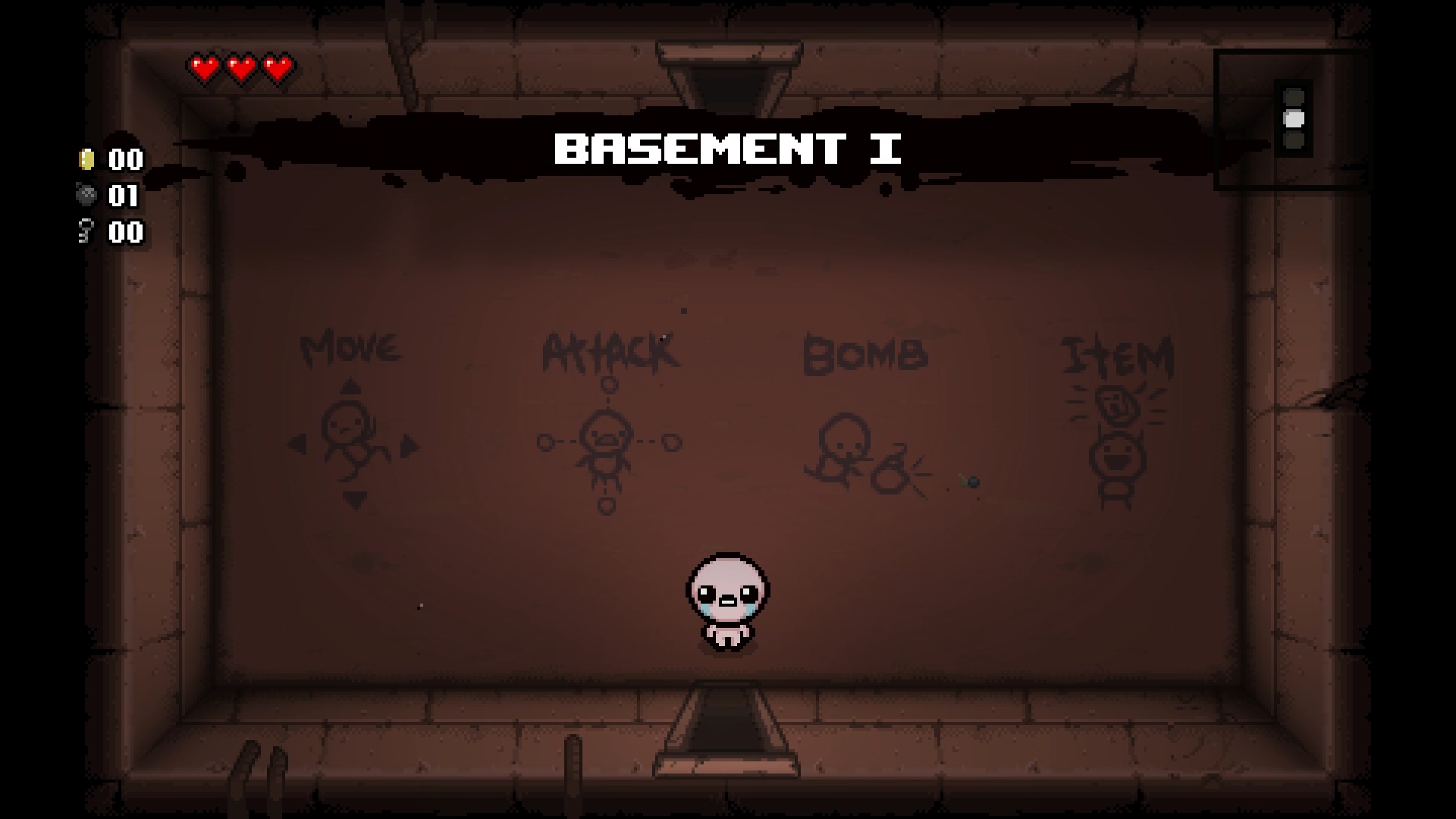
Quite possibly THE most famous roguelike
video game of all time.
How do I approach such a massive product… well, might as well start with the beginning. The Binding of Isaac is a game that was developed by Edmund McMillen and Florian Himsl, and released in its first version as a Flash game on September 28th, 2011. The game’s popularity quickly rose, leading to an expansion titled “Wrath of the Lamb”. However, the version most people are familiar with is the remake, developed with help from the game studio Nicalis on a new engine, dubbed “The Binding of Isaac: Rebirth” and released to Steam on November 4th, 2014 (this is the version I’m covering today). Multiple content packs were added afterwards, such as Afterbirth, Afterbirth+ and, last year, Repentance. Since there is a LOT of ground to cover, I'll focus on Rebirth and only mention notable differences with later DLCs whenever necessary.


A brief introduction

Though the game is fairly well-known, in case someone reading this doesn’t know, I’ll explain: In short, The Binding of Isaac is a roguelike, meaning that you explore dungeons that are procedurally generated. A run you go through is defined by its "seed", a sequence of letters and numbers that’s randomized at the start of the game. In the case of The Binding of Isaac, it’s a sequence of eight digits and excludes the characters 5, I, O and U, meaning that there are (3281,099,511,627,776 possible dungeons. Any more and I would have needed scientific notation. The odds of playing through the same dungeon layout twice (without tools, hacks, or by generating a precise seed by yourself) are so low, it’s practically impossible.