Watch me on Twitch!

Streaming on Twitch whenever I can. (Subscribe to my channel to get notifications!)
Showing posts with label TV Show. Show all posts

June 11, 2021

Adventure Time: The Secret of the Nameless Kingdom


♪♫ We'll go to very distant lands... ♪♫
The smash Cartoon Network hit Adventure Time was probably one of the most notable cartoons of the 2010s. Truly a cornerstone of the decade in pop culture. It started with somewhat disconnected plots that eventually all tied together into a cohesive story, which is a format I’ve come to love (see: My post about Code Lyoko only a few weeks ago). Finn the human and Jake the dog are very endearing characters, and they’re surrounded by an entire cast of lovable folks, several of which turn out to be a lot more complex than they first appear. Plus I got some cool hats out of it. As I’m writing this, four hour-long specials are being released on HBO Max to offer a form of closure to some elements of the series.

So, video games were made. The only one I’ve played is today’s game: Adventure Time: The Secret of the Nameless Kingdom (which I'll shorten to SotNK in the review), developed by WayForward Technologies, published by Little Orbit. I can imagine the Adventure Time games all try to follow the general tone of the series; very comical, slightly self-aware, with the occasional dramatic edge or pinch of serious. One of the advantages of the universe depicted in Adventure Time is that it’s very wide, and has even extended its scope to alternate realities, so anything’s possible. The games in the series also tend to homage classic adventure games.


I can’t actually pretend that I know the show that well – I saw a lot of episodes, but not all of them, and I haven’t kept such a tight grip on continuity to know how everything clicked together in the end. I lost track about midway into Season 5. Let’s see, the game was released for the Nintendo 3DS in November 18th, 2014 in North America, which means it was released while Season 6 was airing on CN. However, I’d assume this story would fit best around the end of Season 5, as Finn hasn’t lost his arm yet and still wields the Grass Sword. From there, let’s see where this story takes us.

May 21, 2021

Top 12 Best Episodes of Code Lyoko

Okay, let’s call this one a freebie. A week or two ago, I fell back into watching the episodes of Code Lyoko on YouTube. As I said, it’s like a cycle, I go back to them every couple years. This is why I wrote such a long retrospective for the blog, a few years ago. In hindsight, I realize my reason was tenuous at best; even if Lyoko, the virtual world featured in the show, features video game-like mechanics, that element of the series isn’t sufficiently prominent to bundle the show with other media about video games. Still, it’s a show that I actually like to talk about and analyze. I love the progression from a “monster of the week” format (read: where continuity matters very little and episodes are nearly interchangeable) to a continuity-heavy show where most episodes have value in the myth arc of the series.

I hesitated for a while before making this list, because I wasn’t sure I would actually be able to do it. Since I love the show, I feel that it’s difficult to cut down what I feel are the 12 best episodes. There are just so many awesome episodes to choose from! Bad episodes, that’d be easier; actually, I’d have the opposite issue, where I wouldn’t know if there are 12 episodes I’d consider bad enough to make the cut.

Ultimately, I made my picks based on a handful of factors. Quality, of course, but also the originality of the plot, the place of the episode in the greater scheme of things and who it focuses on. It won’t be objective, but I do think most picks on this list are standouts that are commonly agreed upon by fans.

I don’t care if it doesn’t fit with the theme of the blog, I just want to have fun today. Let’s jump into it, shall we?

12. #74: “I’d Rather Not Talk About It”

Jim has almost equally been an opponent
of the team as he's been an ally to them in the
real world, even if he usually doesn't remember
due to the reset button.
One element I like about Code Lyoko is that, when you study the show as it evolves, you can see some of the directorial decisions made throughout, and how they ultimately benefited the story. One of the most interesting elements may be Jim Morales, the gym teacher, who started out as a somewhat antagonistic adult in Season 1, only to become a lot more comical from Season 2 onwards, and  a lot more interesting as a result. His catchphrase, “I’d rather not talk about it”, follows his offhanded mentions of things he may have possibly done in his life and jobs he occupied, several of which are highly doubtful for an unfit middle-aged guy who teaches P.E. at some French school.

In the episode that bears the name of this running gag, the protagonists hire him for a tough physical endurance session, only to be attacked by a XANA-controlled wild boar. This episode shines a light on Jim that we might not have thought about before – he does have a lot of knowledge that proves a handful of his claims. It was a sweet form of insight into a secondary figure that deserves an episode all to themselves. Plot-wise, since Jérémie stayed behind to help Jim, the Lyoko-Warriors had to use the Supercomputer on their own, which is something they learned literally in the previous episode, “Crash Course”. How's that for continuity?

11. #64: “Double Trouble”

Any time XANA got behind the Supercomputer's
keyboard, it did some crazy things. And yet,
wouldn't it have the power to do much more
if it stayed into the virtual world?
The show deconstructs the “Wake up, go to school, save the world” trope so common in children’s media by showing how the protagonists’ everyday lives are impacted by their fight against their enemy. They’re overworked and exhausted, their grades take a toll, they constantly skip classes, and the adults are starting to notice. Season 3 focuses on that aspect, and this episode marks the peak to that plot thread, as Yumi is threatened with expulsion by the principal of Kadic due to her repeated absences.

Things aren’t any easier on the other side of things as XANA, which could by this point exist outside of Lyoko, has taken to deleting the virtual world one piece at a time, which would leave the heroes incapable of combating him. When a XANA-made Jérémie clone almost drowns the real one, the heroes have to jump on Lyoko again; Yumi has to escape from a photography class, with William electing to cover for her. This is the episode where the team realizes they need a sixth member, and decide to add William to the group. Oh, if only they knew…

10. #81: “A Lack of Goodwill”

The real (read: evil) William was noticeably
unimpressed by his clone/double.
Speaking of William Dunbar, he spends most of Season 4 under XANA’s control in the virtual world, adding another layer of complexity to the heroes’ quest to defeat the monstrous program. This forces them to create a clone with basic intelligence, similar to the clones XANA can create, to hide the fact that the real William is gone. That clone is… well… “Dumber than a box of rocks” would be an improvement. Per its limited A.I., the fake William takes everything literally and has no initiative. And yes, many people notice. A program is created to make him a little smarter, but he starts to grow beyond his programming, to the point of acting like a real person. No problem, right? Well… this isn’t a real person, so yes, it’s a problem. It’s unfortunate that the show doesn’t explore this in greater depth; it would be a fascinating science-fiction tale.

Then, the student journal reporters interrogate the clone and learn the entire story. Looking for more, they discover the factory and the supercomputer, just as the real William, still mind-controlled and evil, returns to wreak havoc. It’s an episode with a great story, even if I do wish more was done with the idea of a smarter William clone. It also features the Lyoko-Warriors breaking another Supercomputer by translating their Lyoko avatars into the real world, which was a really cool idea, even if admittedly it takes a backseat here.

9. #37: “Common Interest”

Ah, the age-old trope: Science-fiction writers
think uranium can do anything.
Throughout Season 2, XANA attempts to escape from the factory’s Supercomputer, which would make it much harder to defeat. However, in order to achieve such a thing, it has to survive; hence why it ties Aelita’s being to Lyoko. As a result, both feel the effects of any damages done to Lyoko or the Supercomputer. When one of the quantic computer’s uranium batteries begins to fail, Aelita gets fainting spells while XANA feels its power wane. Something out of its control threatens its victory. It thus makes a surprising truce with the Lyoko-Warriors in order to swap the failing battery with a functional one. Say what you want, it has a sense of self-preservation.

This aligns with other actions it took before, such as forming another truce with the heroes in “Marabounta” (Episode #36), in which a creation of Jérémie threatens XANA, with Aelita caught in the crossfire. It’s fascinating to see how XANA thinks; it’s always a step ahead, but it also isn’t above requesting help if it needs to (especially if it has some bargaining chips). Also note how, in the Season 3 episode “Sabotage” (#61), once freed from the main Supercomputer’s shackles, XANA isn’t above breaking its physical core in order to prevent the heroes from fighting him.

8. #93: “Down To Earth”

"How's my new steed?"
I feel like I’d be missing something if I didn’t discuss one of the final episodes. My choice landed on this one. Bringing William Dunbar back from XANA’s control is an important element of Season 4, alongside destroying Lyoko replicas around the World Wide Web to put an end to all of XANA’s plans. By this point, it’s been revealed that the show’s villain has infected several hundred computers around the world, thus making the team’s original strategy of destroying one Supercomputer at a time futile. However, they do have a plan to bring William back. And it’s about time they act, too, as William’s real parents have shown up at Kadic and can tell that the clone isn’t their son.

Better hope it's the real deal, they were fooled
twice before.

I like this episode as a conclusion of the William arc, but also because it’s where a lot of elements came together: The Colossus on Lyoko, the army of robots (which, while I still think is kind of lame for XANA’s final plan, still turns out to be effective against Odd and Aelita), and of course, the multi-agent program created by Jérémie with a bit of help from Franz Hopper. They do rescue William, but it comes with heavy losses, all of which pave the way to the true final confrontation.

7. #25: “Code: EARTH” + #26: “False Start”

The moment everything changed.
Continuity-heavy serials tend to have one of
those moments. Or, in this show's case, many.
Is it cheating to count two episodes in one entry? The show seldom had two-parters, aside from "XANA Awakens" and the Season 1 “finale”, split in two episodes. Imagine being a kid in 2004/05 watching this show with, let’s say, some rather elastic continuity (the episodes had little to connect them to each other aside from the quest of bringing Aelita into the real world). And then, the show reveals it’s actually going to keep its promise. We’re not gonna wait, like, 5 seasons to see Aelita in the real world? Nope, Season 1 Finale it is. In an era where most cartoons still had a “monster of the week” format, this was a breath of fresh air. Shows with continuity did exist, but they weren’t as common or popular as they are nowadays. It made the entire series a lot more interesting.

The previous 25 episodes were worth it.

The plot of this two-parter is great as well: While picking up the required disks for Aelita’s devirtualization program, Jérémie is harmed accidentally by Jim, the gym teacher. Apologetic and now jobless, Jim chooses to help them with their goal of bringing Aelita to Earth. "False Start" sees Aelita’s first steps at Kadic alongside Jérémie, Odd, Yumi and Ulrich, with Jim living temporarily in the factory. However, XANA takes control of the devirtualization program and sends its monsters into the real world… With how long it’s been and all that came after, we tend to forget just how impactful that season finale was. It forever changed the series’ status quo, something that would happen with Code Lyoko’s other season finales (+ a handful of other episodes).

6. #82: “Distant Memory”

This all looks a little too perfect...
I’ve barely mentioned Franz Hopper so far on this list, even though he’s central to the myth arc, being Lyoko’s creator and Aelita’s father. He has appeared on-screen only a handful of times. And on two of those occasions, he was a fake version created to trick/trap the heroes. In “Distant Memory”, XANA picks into what it knows of Aelita’s memories to recreate the winter cabin she remembers and lures her in with a fake of her father. Since Aelita had been left alone at Kadic due to the others celebrating the Holidays with their respective families, she jumps headfirst into the trap. And credit to XANA, the plan would have worked, had it not been for small lapses in knowledge that clued its victim in. It’s once again up to the rest of the heroes to rescue their friend.

Can't say I like the resolution, but I love
all that leads up to this.

This episode is also quite notable in that this is the closest XANA ever comes to victory; the only reason it fails is that the actual Franz Hopper, now a nondescript ball of light on Lyoko, rescues his daughter in the nick of time. Deus ex machina aside, the episode is fantastic all throughout, and reveals that the show’s villain has become incredibly good at mimicking human behavior, to the point of fooling even those who combat it. And as you can imagine, we’re not done talking about Hopper…

5. #59: “The Secret”

Not pictured: The XANA eyes on Aelita.
As stated earlier in this article, the crux of Season 3 is about forcing the heroes to realize they need help. This is the last William entry here. After growing aware of their machinations (and being rejected by Yumi for the umpteenth time), William learns the group’s secret. The factory, the virtual world, their enemy… All of it. They realize they have to team up with him this one time. XANA’s plan is simple yet effective: Take control of a demolition expert and set charges to blow up the factory. Charges that will remain active even if the tower on Lyoko is deactivated. Brilliant. The fight on Lyoko isn't any easier, either, as the villain's plan involves taking control of Aelita through its creature, the Scyphozoa, since she can delete Lyoko territories and it can't otherwise.

Yumi was right, William wasn't to be trusted...
But not for the reasons she thought.

Meanwhile, at the factory, William points out that the guy was a demolition worker, and thus he helps the others in finding the detonator and stopping it before the factory explodes on them. In spite of his best efforts, he is not accepted into the team, due to Yumi voting against it (but William believes that Ulrich’s to blame on that front). I think this is the best William-centric episode in the series; it’s smart, has some great moments, and helps to further the point that Season 3 wanted to make. Of course, at the time, I doubt anyone could’ve guessed how thing were actually going to go…

4. #19: “Frontier”

It's unfortunate that the show barely did any
of that 2D-CGI mix like we have here.
Then again, could they have?
In the first season, episodes that focused on the myth arc weren’t common, so they stood out a lot more. Frontier is one of these. After getting into an argument with Aelita, Jérémie tries to go to Lyoko to apologize in person. However, something screws up during the virtualization process and he winds up trapped in limbo between the real and virtual worlds. In order to rescue him, Aelita needs to gather the necessary data. Meanwhile, Odd, Ulrich and Yumi are like sitting ducks against a potential XANA attack, since the only member of the group who can use the Supercomputer is out of commission (and at risk of disappearing forever). Jérémie is rescued in the nick of time (as per usual in Season 1) and has a short moment where he almost reaches Aelita through this bizarre limbo. One of the most powerful emotional moments of the season. It also tempted fans with the prospect of seeing Jérémie’s form on Lyoko… which we never do, and we’re told it’s better that way. The show would rather not talk about it.

"Jérémie really ought to teach us how to do
this on our own."
"No worries, we just have to wait 54 episodes!"

3. #49: “Franz Hopper”


That's some dark glasses there.
Makes it easy to hide some XANA eyes.
Ah, there he is again! In this episode taking place near the end of Season 2, XANA hides behind the guise of Franz Hopper. Using the argument of appeal to authority, XANA rallies Odd, Ulrich and Yumi to his side, turning them against Jérémie by claiming that the virtualization process is causing cellular deterioration in Yumi. And this, on the preteen genius’ birthday! The fake Franz Hopper appears very professional, human and fatherly – one of XANA’s nigh-perfect attempts at mimicking human behavior, to the point that the only element that gave it away was a slip of the tongue, mentioning something that it would know, but that the actual Franz Hopper wouldn’t. And when Jérémie arrives to confront the fake researcher, the rest of the group is already in danger’s way on Lyoko, made defenseless against the mooks! It’s only quick thinking and some sweet trickery that allows the team to beat the villainous program this time. This episode shows how far XANA has come to understanding the human psyche, and how dangerous it can be when utilizing that knowledge. It’s also a great episode on the “slice of life” side of things, with the drama around Yumi’s so-called affliction.

Three boxing rounds against the Rampant!
It's Punch-out time!

2. #30: “A Great Day”

Oh right, there was also that friggin' thing from
Season 2 onwards. A sign that XANA had
grown very powerful.
I don’t know why, but I’ve always loved “Groundhog Day” plots. I saw “Happy Death Day” recently and loved it and- I’m straying from the point. This may be one of the best twists on the idea. XANA gets its grubby AI mitts on the Return to the Past feature of the Supercomputer, and it becomes a race against time to deactivate the tower on Lyoko before it resets the day again. But, why would it do such a thing? The revelation is shocking: Every Return to the Past increases XANA’s power. This episode sets two things in motion: The heroes have to use the Return to the Past less often from now on, lest they want to fight against an enemy constantly improving. And two, the evil program has at that point grown powerful enough to take direct control of human beings. This episode changed the status quo forever, and it’s not even a season finale. It’s also a great story on its own, between the XANA attack and the Kadic School side of the story, in which Sissi tries to blackmail the Lyoko-Warriors with an audio file she recorded of Jérémie and Aelita talking about the latter’s (then) mysterious origins.

Noticed how this is the only mention of Sissi
on the entire list? Gee, it's almost like I think
she's an annoyance or something.

1. #24: “Ghost Channel”

Which one is the real Jérémie?
It was a tough choice between this and “A Great Day”. I ultimately went for this one because I think it’s the most interesting story the show got to tell. After fending off a XANA attack and launching a Return to the Past, Jérémie notices that Yumi, Ulrich and Odd haven’t returned. Meanwhile, they’re in class somewhere else with a strangely antagonistic Jérémie. The nerdy kid gets in trouble with the school over the disappearance of his friends, while the rest, in the other version of Kadic, are noticing bizarre glitches in the matrix. It turns out that they’re still on Lyoko, in a bubble that replicates Kadic School and its surroundings.

Looks like this Matrix needs a quick reboot.
Listening to his courage and proving that he’s a true Lyoko-Warrior, Jérémie goes into a scanner and gets himself virtualized, and this, in spite of what happened the previous time (see my entry about "Frontier"). The mere concept of “virtual bubbles” is fascinating, yet only used twice in the show. I love the creepy feel of the false Kadic, with random things repeating movement patterns (the aforementioned “glitches”). I really think it uses the full extent of the universe’s elements (or at least what existed at that point, in season 1), to create the most interesting story possible. It’s also in a fantastic spot in the season, right before the season finale. And, oh yeah, that evil Jérémie is frightening as Heck! This episode deserves its #1 spot.


This is it, this is my list. Hope you enjoyed! I should return to my regular programming very soon.

March 9, 2018

Rabbids Invasion: My Episode Suggestions

Okay...I’m not planning to make a full-on post about this. Rabbids Invasion has a LOT of episodes, so a Top 12 is almost impossible, and besides these episodes are too short to warrant that much text. Instead, here are some of my favorite episodes; feel free to check them out whenever you want. I’ll just say why I like these episodes.

Go here to read the Rabbids Invasion review.


“Rabbid, Are You There?” – The Rabbids set out to mimic a burglar breaking and entering into a house, and their antics prevent the burglar from succeeding in his task. Said antics also end up affecting the apartment above, in which a fake psychic is trying to scam people into giving him more money, pretending to speak to ghosts and spirits. Two plots that combine in a smart way!

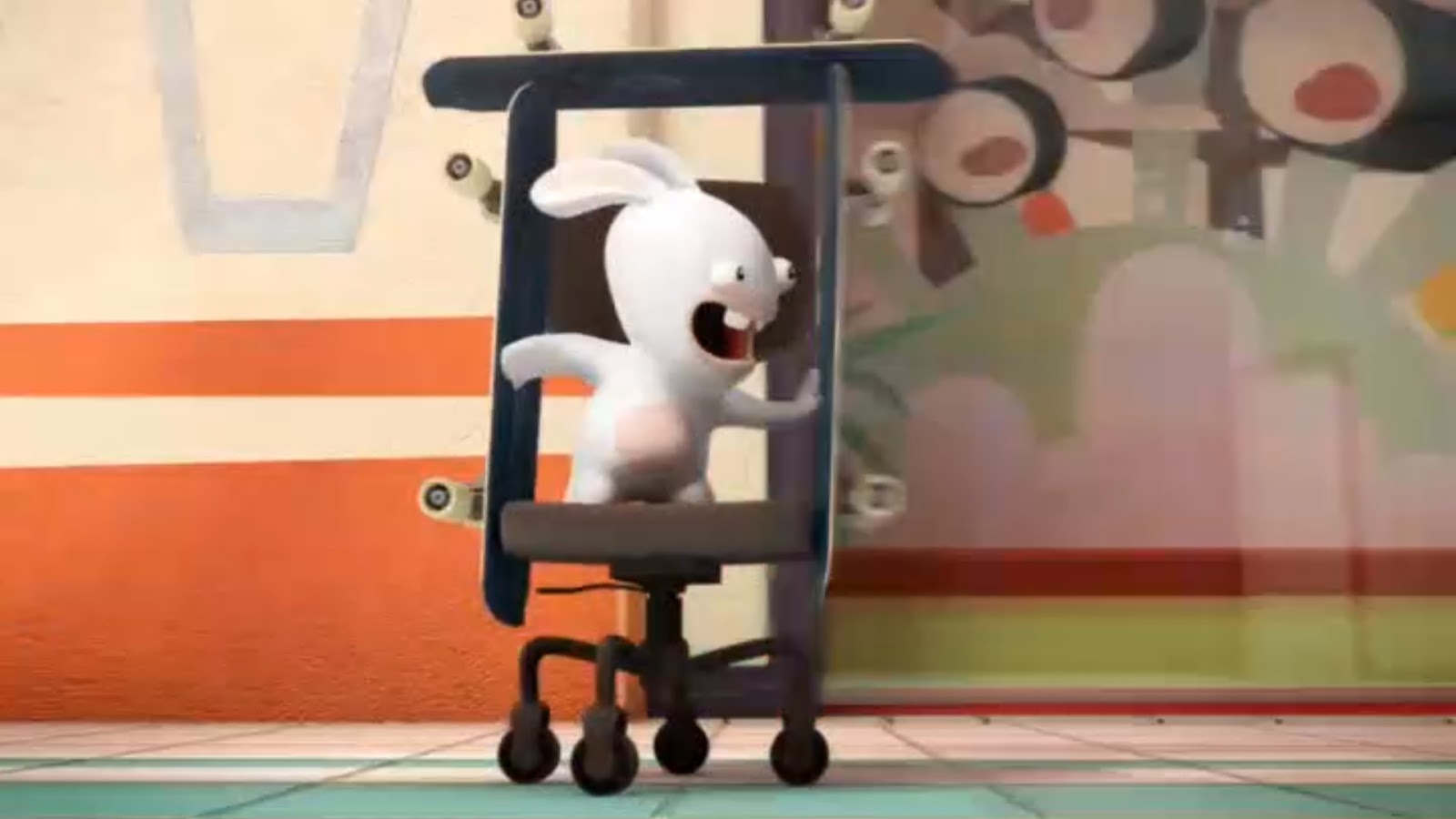
This is entirely too much work for something that could
be solved in 5 seconds. Rabbids in a nutshell.
“Escalator Rabbid” – One bunny is trying to climb up a descending escalator, so he can reach the bunnies on the next floor and get some of their candy. He thinks up a dozen different ways to achieve this, yet keeps failing – while completely missing the fact that there’s an escalator going upwards only a few feet away! This one shows that the Rabbids are very stupid, but also bizarrely resourceful, even if the solutions they find are complex and ineffective, and the best solution, the obvious and easy one, is invisible to them.

“Omelet Party” – The “pilot”, in which Rabbids stumble upon a chicken coop, start racing using chicken as steads, then learn to provoke egg-laying from chickens and use them in an egg shootout… In other words, the absurd and silly stuff you’ve come to expect from these idiots.

Is that a... Jesus analogy or something?
“Rabbid Test No 98005-C: The Blue Rabbid” – In my eyes, the BEST episode of the show. John and Gina, the scientists, watch over seven Rabbids in their test chamber, and decide to paint one blue. What follows is a lesson in prejudice as the Rabbids belittle the lone blue bunny, and then the second one that Gina also paints. She turns two more blue, with the unpainted ones now the minority that the blues start belittling. This leads to a battle between both groups. Eventually, Gina erases the paint off one side of a Rabbid, making him half-blue half-white, and this one reunites the Rabbids as friends again. Touching, smart, and deeper than you’d expect from such a show.

While John panics in the Rabbid body, the Rabbid...
starts acting like a bird.
“Being Rabbid, Parts 1, 2 and 3” – Yes, the laboratory episodes are some of the best, and we have a trilogy here. In trying to comprehend the Rabbids, John switches brains with one of his test subjects. The Rabbid in John’s body gets into the control room… When Gina arrives the next day, she sends John in the Rabbid body out to the junkyard near the lab, where the bunnies regroup. Since he speaks human, the Rabbids start treating John like a king, but he manages to return to the lab… only for the brain transfer, done by Gina, to go wrong and leave Gina into the Rabbid’s body now. When she is sent down into the junkyard accidentally, she meets Lapinibernatus, the smart prehistoric Rabbid, who creates a Rabbid-to-English wristwatch translator so that she can understand him. Finally, a smart person Lapinibernatus can talk with! Unfortunately, John arrives, rescues Gina (leaving Lapinibernatus behind), and sets everything right, restoring Gina to her real body. Phew! These episodes would probably be together as #2 on my list of favorite episodes. The third one, in particular, is very touching.

A perfect Rabbids Invasion movie would have Gina
look for Lapinibernatus to help learn more about the
Rabbid species, since he's smart like a scientist.

Examples include "Diet Rabbid", in which one Rabbid tries
to slim the others down with exercise so they can enter
their makeshift machine. Problem being, they made the
entrance was too small, and no amount of exercise could
make them slim enough to go inside.
“The Rabbid Games” – The Olympic Games, in alien bunny flavor and all the stupidity they display. The running gag of the “female” Rabbid trying to sing and being constantly interrupted is a highlight.

Many episodes from Season 2 in which the bunnies try to get to the Moon. These include “Diet Rabbid” (in which one puts the others on a diet to go into their space shuttle, even if the diet is ineffective because they forgot to make a wide entrance on their shuttle) and “Green Rabbid”, which has them building a pile of stuff like they do in Rabbids Go Home.

Rabbids know Elvis? ....Impressive.
“Rabbid Anthem” – The Rabbids make a singing talent show in the junkyard, to find the perfect one to sing their anthem before they send one of theirs to the Moon. However, there’s only one participant, who tries over and over with different disguises, and he sings horribly off-key… until he inhales helium and does an adorable Elvis impersonation. And then, sometime later, the helium wears off. That one has laughs, cuteness, and drama when it all goes south.

“Ring! Bwaaah!” – After multiple episodes speaking on flip-flops as if they were cell phones, a group of bunnies suddenly gets a real smartphone… and proceed to “discover” it in true Rabbid fashion.

So wait, the Rabbids are dreaming of conducting actual
experiments on humans? Holy crap.
“Queen of Rabbids” – The Rabbids steal a magic kit for kids out of a store… and Alice, who had it in her hands, follows them. She proceeds to astonish them at the junkyard with the various simple magic tricks she knows, and they start treating her almost like a queen.

“Rabbid Dreams” – Ending this list on an unsettling episode, where the scientists attempt to comprehend Rabbids by observing their dreams. Things… get weird from there. Seriously, don’t mess with dreams.

That’s it for the list. Enjoy, seek these episodes, discover the show. This Friday: Rabbids Rumble.

Rabbids Invasion

Well! This is probably the worst title card I've ever made!

The Raving Rabbids. What else is there to say? You’re free to enjoy them, you’re free to despise them. Personally? I like them. They’re… I’m not sure how to explain it… A study on stupidity. They’re idiots, all of them. The rare few smart Rabbids would still be dumber than any American animated sitcom dad of your choice. Their utter lack of comprehension of human society leads them to screw up even the most basic of tasks, in completely unexpected and unpredictable ways. It takes a lot of creativity to ditch all logic and imagine how these creatures with failing knowledge of our customs, lacking in the IQ department, would approach each new discovery.

At least they're not the Minions.
Multiple games, a TV show, gag-per-page French comic books… the Rabbids have outgrown the Rayman series and took control of anything they could get their mitten-like hands on. A multi-media franchise. There's the games, of course, and I spent an entire month back in 2015 discussing no less than 4 Rabbid titles and the various mini-games they contain. And spoiler alert, two more Rabbid games will be reviewed this month. There’s a lot more to say about this franchise than you’d think.

I posted a quickie review of the French comic books here; at first, I was planning to add it to this review, but it would have made for a very long article. Go and look it up here.

Well, I can throw away my atlas now. It's become useless.
We can now start talking about the actual TV show, Rabbids Invasion. It was created by Ubisoft Motion Pictures and co-produced by Nickelodeon and Ubisoft Entertainment. Of note, while the Rabbids of the games are voiced by Yoann Perrier, those of Invasion are voiced by Damien Laquet, who does a mighty fine job in the art of lagomorph gibberish.

The intro sequence sets the tone: Hordes of Rabbids running around, dragging ropes, stringing up entire continents… zoom back and Planet Earth’s lands have been cut up and reshaped to form a giant Raving Rabbid. Well that’s a novel way of “taking over the world”…

No! Not the Statue of Liberty! I am fairly certain it doesn't
like getting tied up like this! ...Or maybe it does?

As for the series itself, you might think there isn’t much to say. You'd be mistaken. There is, indeed, more to be said about this silly little TV show about unintelligible alien bunnies than it seems at first glance.

February 2, 2018

Top 12 Fourth Wall Breaks in Sonic Boom

For a while I’ve wanted to make something more special as a Top 12. It’s been six months since I last discussed Sonic Boom, and Season 2 has had a satisfying 2-part finale. I’ve wanted to make a list about the Sonic series, but I couldn’t find any ideas. I thought about a list of best secondary characters, but the definition of a “secondary character” is pretty elastic from a Sonic game to another – anyone aside from Sonic could count. So, I settled again on what I knew. And what do I know? Sonic Boom.

"I don't get it. We followed the instructions, we did everything required,
we even gave fans what they wanted. And Sonic Forces only got a 57
on Metacritic?"
"Maybe we should try the Mania route again."
"I told you that Infinite guy was a bad idea!"
"Of course it only got a 57. It didn't have enough chili dogs."

As I said time and time again, the Sonic Boom TV show is one of the more impressive tour de force achieved by the franchise. The games associated to the Boom sub-series weren’t too great, and even the current new Sonic games (aside from Sonic Mania) have received lukewarm reception at best. That’s a shame too, because I had high hopes for Sonic Forces. However, the current TV series goes on, undisturbed, with brilliant writing and tons of great ideas. Partway into the first season, the show started breaking the fourth wall more and more. By this point, they aren’t just breaking the fourth wall. They’re punching through it, blowing it up with dynamite, carrying all the remains into an empty field and dropping an A-bomb on it, just to be sure that it’s obliterated for good. And there’s Deadpool on the sidelines, looking at his Adventure Time watch and going “Come on guys, leave some for me!”

There are plenty of ways to break the fourth wall: Address directly the viewer, have the characters acknowledge that they’re in a work of fiction, reference the grander scale of the franchise (if any). The Sonic franchise can even go a step further since, as a long-running franchise that has been going on for over 25 years now, it has gathered a gigantic fanbase (of which the quality is… um… variable) and that fanbase has contributed with fan works and memes, which are all elements that a fourth wall-breaking joke can pick from.

Sonic Boom has broken the fourth wall so often, I could make two lists like this one. But I’ll do only one, because we really don't need more, no matter how many seasons this show ends up having. I could do a Top 12 Sonic Boom episodes, but I feel like I’d be cutting out tons of episodes that I also love. Sure, I could instead do a Top 24 list split over two articles… but that would still be a lot of work. Have the current list where I explore the many ways that a show can break the fourth wall, and many great examples from a single show (and, on a rare few occasions, the games).

Only one rule: Each episode must make the list only once, because many episodes feature multiple noteworthy instances of fourth wall breakage.

January 1, 2018

The Disney Afternoon Collection (Part 4)

Chip’n’Dale 2 / Conclusion

(Before we start... I want to wish everyone a happy new year. May your 2018 be better than your 2017! And if your 2017 was great... then, may your 2018 be even better!)

Chip’n Dale Rescue Rangers 2


This game starts as Chip and Dale learn through a news report of a bomb threat in a restaurant located downtown. They decide to go investigate. As soon as they leave, the news report continues, announcing Fat Cat’s escape from prison…


First thing you notice: The game has animated cutscenes, not only text with still images. Some effort went in this!

Boxes! Boxes boxes boxes... BOXES!
Second thing: As with any sequel, the controls are a little different. Now, Chip or Dale can even throw items diagonally. This is bound to be useful at some point, right? One downside is that, now, if you want to throw a crate near the floor, to hit an enemy’s bottom, you can’t shoot until the chipmunk is hidden inside the box. I suppose that made the previous game too easy! Once again, you only means of defence is to pick up boxes and throw them around. I suppose the steel boxes were OP, because they’re mysteriously absent outside of rare instances where you must cross a bed of spikes to reach the next platform.

DIAGONAL TOSS, MOFO!

Oh, I just love going into sewers... always makes for
pleasant levels... bleh, it stinks down here!
In the original Chip’n Dale, there were two levels you could skip. Here, none. But that’s okay, it’s about the same length anyway. The levels are once again split in sections, so you restart at the beginning of the section you died in instead of restarting the whole level (unless you get a Game Over and use a continue, which takes you back to the start of the level). The flowers from the original have been replaced by RR symbols, for Rescue Rangers, and the stars are almost absent – since this time around, stars are clear 1-Ups. You can collect up to 99 RR symbols in a level, because that’s where the counter ends. In the first, each time you collected 100, the counter went back to 0 and you gained an extra life after a level. Here, once you get 50, you gain a larger RR emblem, which stacks wth the previous ones earned. The use for those is never explained in the game, but I noticed that once you had collected enough of those, you gained extra hearts for your life bar, going from 3 to 4, and then 5. So, you know, the game at least stays fair by giving you more HP for the upcoming levels… It’s also very easy to reach 50 RR symbols in a level (note that they all respawn if you die). You can only get one larger RR emblem per level, too – since the counter ends at 99, you can’t get to 100, which would give you two emblems.

Ready to go again!
The next thing you notice is the difficulty level. Much like in Darkwing Duck, many enemies here take more than one hit to go down – and many others have effective means of defending themselves against the crates you throw at them. We even get enemies disguised as crates in the first level! You don’t expect this kind of trick so early into the game! Indeed, I personally believe this game is harder than the previous one. However, it’s merciful: Three lives each time, three continues. That should give you a chance to learn the game. And thank God for that!

You gotta wait till this guy spawns a rock before you can
properly hurt it. Even there, you gotta strike before it
vanishes.
The levels are tricky, but so are the bosses! You know how, in the first Chip’n Dale game, you always had a red ball to throw at the boss, from the start, and you could always pick it up again instantly? Yeah, they got rid of that. Instead, all bosses must be killed by the crates and blocks that either fall onto the field or are summoned by said bosses. The first, Water Rabbit, must be killed with crates that fall from the top of the screen. Did I mention that this takes place in a giant dishwasher, and the water currents drag you and the boxes downwards? It keeps going, too: The second boss, a flying cat (BatCat?), throws rocks that must be picked up and thrown back at it. A ghost summons rocks, a wrecking ball on a machine hits the ground to produce blocks… You get the idea. Also, unlike the original, most bosses here actually freaking move around the screen. NOW that’s some difficulty! I mean, I don’t like when things are too hard, but when they’re too easy it’s no fun either. The bosses here are harder, and that’s good! Many of them are pretty long to beat, though, since you must rely on blocks summoned by the boss or the field.

I have to make this bomb blow in this robot's face!
...Or else, it's gonna blow up in MY face!
The final boss, in particular, is very difficult. It’s a robot version of Fat Cat, and it has many different attacks. Its main move is to rise and disappear at the top of the screen, drop a bomb, and fall down shortly afterwards. You have to pick up the bomb and throw it at the boss… but only when it reaches the 0 of its 3-second countdown! For, you see, getting hit by the bomb won’t harm it, only the explosion will. And it has about 10 Hit Points, with some attacks that are easy to avoid, some that are predictable due to their telegraphing… and, for some reason, one that causes the game to lag a bit when it happens, but it’s not too bad. Once the Fat Cat robot is broken, we get a final cutscene in which we learn that Fat Cat escaped, but since we’ve laid waste to his primary base of operations, the Rescue Rangers should be able to deal with him soon. The end!

Yeah… that’s it. I’m a bit disappointed as a Steam achievement about beating this game said “Return Fat Cat to the slammer”, and that doesn’t even happen. Oh well!

Chip'n Dale 2 has a lot of tricky platforming section, as well
as devilish sections like this one.
I’m a bit torn on this one. While the graphics and music are still very good, a staple of all Capcom Disney titles in this collection, I have a few criticisms about the controls and system this time around. The difficulty level has increased, but the game as a whole is still fair – I’d even say it’s more creative than the first in that it tries to think up good reasons for crates and other blocks to appear during boss battles, sometimes with unique twists. They did away with the apples and the bombs from the original, kept in the steel blocks (which appear only twice), and the red balls appear only during the bonus game at the end of a level (in which it’s a lot trickier to get an extra life than it was in the first CnD game). The increase in Hit Points is also welcome, considering the rising difficulty of the later levels.

Big cogs everywhere? What is this, Great Mouse Detective?
The controls still work fine, and I’m glad that we can now throw diagonally upwards (that would have been useful before!). However, some changes to the system annoy me, like the clear delay needed before Chip or Dale can throw a crate at ground level. They absolutely have to be hiding in the crate before throwing it that way, which is annoying when you’re trying to kill enemies smaller than the chipmunks. The game also makes frequent use of moving platforms, like treadmills in the final level, or spinning cogs in a clock tower level (in my opinion, the most annoying of them all). The NES graphics can do wonder, but sometimes you can’t tell the direction in which a cog is spinning until you jump on it. And, well, sometimes you get tossed off the platform and to your doom (since the game scrolls only forward and there are many sections where Chip or Dale is going upwards, with the bottom of the screen turning into a deadly pit). Also, the RR enblems should have been explained better.

All in all, a very good game, some good improvements, although I’m not sure I like it more than the original. It’s pretty good, definitely not a bad game, but I don’t see it as quite as good as some others in this collection.

Conclusion


Can you make it into the Top 10?
Because I sure as Hell can't.
Well, that was quite a ride! To properly do this review, I had to beat each game in each available mode.

I started with the Boss Rush Mode, since it was the shorter one and it would give me a chance to try out the controls before getting into the various games. Playing on a keyboard isn’t the same as using a USB NES controller. To its credit, this mode pits you against all the bosses in each game, although it’s always in the same order (either the order of progression or the order of difficulty).

Got 4 Hit Points here because it's the normal Play mode.
In Boss Battles, you gotta survive with 3.
Might as well give up. Or maybe not.
There’s also a little problem with this mode, when it comes to games where you can get extra hit points: It’s not consistent with these. In Chip’n Dale 2, you almost instantly get extra hit points, up to 5, as you progress. And you start the Boss Rush mode with these 5 Hit Points. In both DuckTales games, the additional HP are either found or bought. And as a result, you go through the Boss Rush mode with only 3 HP the whole time. Yes, even against the freaking golem in DuckTales 2. Good luck! It’s a bit of a problem, though if you know the bosses you can defeat them with relative ease (after all, the point of Boss Rush is to speedrun through them and get a low end time).

The Play option is just that: Play the game as it was meant to be played back when it was on the NES… with a slight difference. You can Rewind your playthrough (usually with the Q button) for any major mistake you made, allowing you as many tries as you want – which, okay, I suppose that’s a nifty feature for young players who are discovering these games, or for people who just want a less-effort playthrough. Just go through the levels, rewind if necessary, beat the game. There’s one achievement for each, and you don’t lose the achievement if you rewind.

The Time Attack mode is where it gets tough: Once again, you play through the whole game (including menus and cutscenes, but it ends as soon as the final boss is defeated). This time, however, rewinding is not allowed, and the timer never stops unless you leave the game and restart (or pause the Disney Afternoon Collection, not the single NES game). The timer doesn’t start over if you get a complete, no-Continues-left Game Over, either. But don’t worry, the achievements are actually very easy to get, as long as you can beat these games in less than 2 hours each. Many of them can be beaten in a third of that time, with enough skill and luck.

If you devote about twenty hours to this game, you should go through the whole collection relatively easily and collect every achievement (including the one in which you must beat any game without rewinding). The collection of achievements is pretty basic, really - a little too basic and simplistic, in fact. It’s a weird point of criticism to have, but I have it. (I’ll say more later).

"I am the bat with fake wings that hookshots at
fixtures in the night! I am... Darkwing Duck!"
There isn’t much to say about the Collection itself. It’s great that it features all of the musical tracks from the six titles you can play here, and I also like the Gallery – it also offers loads of information you might not know about the production and content of these games. However, it seems to be quite unequal in the presentation of bonus content, as though there was more to show about the more famous titles. I would have liked to read more trivia about DuckTales 2, as an example. Then again, if there’s little to say about one of these games, I guess it makes sense that they wouldn’t be discussed as much.

A final thing about the achievements: There could have been a few, more special ones outside f the obvious stuff. Here’s a few I can think of:
-Beat a game that has Continues without using any;
-Get the best ending on either DuckTales game;
-Get the worst ending;
-Beat Chip’n Dale 1 without skipping any levels;
-Find every secret million-dollar treasure in DuckTales 1 and 2;
-Buy all of the upgrades in TaleSpin;
-Beat any final boss without getting hit once.

But really, that’s just a minor point of criticism. All in all, this collection is awesome, and if you’ve ever owned any of these classic titles, or wanted to own any of these classic titles, or played DuckTales Remastered and want to try the original one… Seriously, whichever the reason you give yourself to get this game, you really should. The Disney Afternoon Collection is amazing. Worth the price you pay for it!

Next week… something different!