Watch me on Twitch!

Streaming on Twitch whenever I can. (Subscribe to my channel to get notifications!)

June 10, 2022

Quick Review: DETOUR


I had heard that roadwork was a cutthroat business, but this is ridiculous!

Why did the road cross the map?
Developed by Geoff ‘Zag’ and Richard Keene, published by Geoff Keene and released to Steam on May 16th, 2011, DETOUR presents an interesting take on a resource management sim, by combining it with real-time strategy. You are a new hire to a roadwork company, building roads that lead from factories to the rest of the world. To do this, you create streets, bridges and tunnels leading a truck across a map. You need to spend credits in order to build a road on a square of land or send a truck going. The fields have other types of obstacles such as unbreakable mountains, as well as things that can help such as gold mines to get more credits or pre-built roads and towns to save some money. Get three trucks across the map, and you win!

That's still the easy part. Wait till the others
join in.
It’s not gonna be that easy, however; soon, you’ll encounter opponents who also work in the business and who want to get their trucks through before yours. This is where the real-time strategy comes in. To cause trouble, both you and your opponents can plant bombs to destroy squares of roads, packs of nails to incapacitate trucks, or cause hippie protests in the other’s path.

And yes, opponents is plural. After the first set of 9 levels, which serve as a tutorial of sorts, we jump into the meat of the action, where both genres are combined and you have to deal with three opponents who are also trying to get ahead. There are three sets of 9 levels total, for a total of 27. Though if that doesn’t sate your real-time strategy resource management, you can go down to Multiplayer and either get this game for your friends and play against them, or play against CPUs.

Oh nice, the opponent is throwing a bomb
or two my way. Such healthy competition.
This one’s not too great. It’s a novel idea that’s been seldom (if ever) done before, but the execution doesn’t do it justice. 27 levels isn't much, but the levels compensate by being somewhat long. The biggest offender is the difficulty curve; after you complete the first 9 levels, you’re thrown directly into the competition against 3 CPUs, all playing savagely. You don’t even have time to adapt your strategy to the map! What’s worse, even if you can work the menus efficiently, most of the tools come with nasty drawbacks; as an example, if you blow up a few squares of road, you must wait for “the dust to settle”, meaning that nobody can build on those squares for a couple more seconds – further hindering you if you were on the receiving end of that maneuver by an opponent. Things get chaotic when four opponents are tossing bombs at each other.

Each of these explosions might as well pop a
big F YOU up on the screen.

There isn’t really much of a story, and the characters aren’t too great. (Also, one of them has a really unfortunate name.) I wouldn’t call this one worth trying out. No need to make a… detour towards it. …Alright, that was bad even by my standards.

Also, its developers have moved on to making better games. Anyhow, if you do want to try this one, DETOUR is available on Steam for 1.99$ US.

June 8, 2022

Quick Review: The Deadly Tower of Monsters


It’s a miracle that this director hasn’t been struck with half a quadrillion lawsuits. Or that he somehow gets to commentate on his own films. He sounds like the type who’d produce so many bombs his career would be a complete minefield.

Without the "commentary" both audio and
at the bottom of the screen, this would be a
pretty basic action game.
Developed by ACE Team, published by SEGA and released on January 19th, 2016, The Deadly Tower of Monsters is the crown jewel of director Dan Smith’s filmography, originally released to theaters in the ‘70s, and he was brought back on to provide a commentary track for the DVD re-release. The “game” is basically the film, in which you control the heroes as they climb the titular tower to face off against the Emperor of Planet Gravoria. The characters are Dick Starspeed, a regular human who crashed on the hostile planet; Scarlet Nova, the Emperor’s daughter now rebelling against him; and Robot, Dick’s co-pilot, who gets rebuilt but was never given a name. Now, let the film play out while Smith comments, with every trope of filmmaking lampooned to Hell and back.

Not pictured: The stilted, shaky movements
done by the stop-motion King Kong.

Being able to shoot down from a ledge is an
interesting meahcnic, but it also causes
some headaches from time to time.
There’s a lot of controls to this one: WASD to move, aim with the mouse, left- and right-click to attack with the melee and ranged weapons respectively, swapping between weapons with Q and E (you gather various weapons throughout but can only carry two of each type). Press Space to jump, F to change the view to look downwards by a ledge (enemies may come from there), Left-Shift to do a rolling dodge, Z to activate a special move (each playable character later gets their own unique ability), C to teleport back to a ledge if you fell off it, and M to open the teleportation console. You can swap between unlocked characters at certain stations, and you can also use other stations scattered around the Tower to change your weapon loadout, upgrade the weapons using the Gold and some resources you can gather, or upgrade your character. The method to do the latter is a bit weird, though; you can only upgrade the astronauts by completing the in-game missions. For each mission completed, one more upgrade step is unlocked.

Can you see the strings?
The developers went the distance to make the game look like a cheap B-movie production. You can see strings on flying enemies, several others are explicitly said to be people in suits, and then some others are animatronics or stop-motion (such as the big ants or the Mega-Gorilla that serves as a boss). The costumes are lame even by the standards of the in-game film’s ‘70s release date. And that Smith guy? He’s got the arrogance and the budget of James Cameron, but the level of talent of Tommy Wiseau.

If you don't obsessively search the map for the
golden cogs, there's a lot of weapons you won't
be able to upgrade.
Pretty fine game with nice gameplay and a very clever idea, but not without its flaws. The soundtrack is pretty forgettable in my opinion. Aiming can get pretty tricky with your crosshair often being hard to find, and the camera is frequently a bother. The framerate could also spell trouble, to the point where it could make some parts impassable until you lower the settings – one glaring example is the treadmills that only Scarlet Nova can cross with her unique special ability, which is impossible if the framerate makes it so that Scarlet cannot run far enough to reach the other side.

No word on how they managed to do THAT
effect.

Come on... come on... get through... Fu-!
Why the Hell can't she go all the way to the
end of the goddamn treadmill? She's supposed
to be able to!
Although the concept of this game being a film getting commentated by its director is nice, ultimately the jokes will mainly appeal to movie buffs who can laugh at the absurdity of everything that supposedly took place during filming. At least the low-budget sci-fi pastiche hits all the right notes, with a style that mimics the special effects of the time; I wouldn’t go as far as to call it style over substance, but it didn’t leave as much of an impression on me as I hoped it would. It’s not bad, though; I felt it was average, but I like the idea. If a top-down beat’em up claiming to be a movie sounds like something you’d like, then, by all means, get this one.

The Deadly Tower of Monsters is available for 14.99$ USD.

June 6, 2022

Quick Review: Day of the Tentacle Remastered


Gotta stop the Tentacle, or everyone will have a bad time!

Day of the Tentacle was originally a point-and-click game released in 1993 by LucasArts. It was  meant as a sort-of sequel to a game called Maniac Mansion. The version covered today is a remaster developed by Double Fine Studios, who made a lot of graphical upgrades to the look of the game.

They bothered to spell HELP in red, it must
be very important.
Two Tentacles (literally two creatures that are nothing but a tentacle each) approach toxic sludge being dumped in a river by the mad scientist Dr. Fred. One of them, Purple, tastes the sludge, grows arms, and becomes evil. They’re then captured by the scientist. Far away, Bernard Bernoulli, the dictionary picture for a ‘90s nerd, receives a letter saying that his Tentacle friends have been kidnapped; he enlists the help of his college roommates Hoagie, a metalhead, and Laverne, a somewhat unhinged medical student, to rescue them. Unfortunately, this was the wrong thing to do, as Purple upon freedom begins to plot for world domination.

This looks like the worst possible idea.

Includes violence against balloon clowns!
(You do much worse to that balloon later.)
To stop him, the three ask Dr. Fred for help. Just their luck, he has a set of “Chrono-Johns”, three porta-potties refurbished into time machines that he can use to send them a day back in time to stop Purple. However, a malfunction causes Hoagie to be sent 200 years back during the Constitutional Convention where the Founding Fathers are working on the paper, while Laverne is sent 200 years forward, to the future where the Tentacles have won and humanity is enslaved. The two need to find some way to power their Chrono-Johns to come back to the present. Meanwhile, Bernard has to coordinate the team split across three time periods (and find a diamond to power the core machine) in order to then save the world from Purple.

Hancock, Jefferson and Washington. We're just
missing Franklin and we got a full band.
Point-and-click games tend to follow the same formula: Pick up items, talk to people, and solve puzzles using both. And sometimes, the puzzles will get real damn silly. Day of the Tentacle adds a fourth dimension to it all, as you play three different characters in three different situations (though all of them visit the same motel, different in each time period). Thanks to the Chrono-Johns, you can actually send items between time periods in order to have either protagonist use them, which is vital to solve many of the puzzles. However, living creatures and large items cannot be sent that way… though there may be alternatives. And of course, changes made in the past will affect the future in some way.

Hey, kids born after 2004: Ever used a VHS?
Well, time to learn.

Apparently, in the future, tentacles use
present-day bug nets to hunt humans.
Sure, that'll work.
As is to be expected, the puzzles can get pretty complicated – factoring in all three time periods means that each character can use most items, leading to a lot of trial and error. There are hints to be found, thankfully. The game is also designed like all point-and-click titles should be: It’s impossible to lose just by throwing away an item. If something leaves the inventory and cannot be retrieved at all, you’re effectively done with that item. Some things aren’t fully explained either; as an example, I thought I had to use the Chrono-Johns every time I wanted to send an item to another character, whereas apparently it was possible to transfer items directly through the menu past a certain point of the story. I could have saved so much time and so many trips back and forth!

A hamster, a pot of coffee, a brush and a
bar of soap. That sounds like set-up for a
comedy film scene.
Fully-animated, the game is also fully-voiced, containing voice clips for damn near every option – whether you’re looking at something, about to push or pull it, or anything else you’re about to do. Adding to this is a number of nods and references to the original Maniac Mansion, with the full version of it playable on a PC in the present. Since the storylines happen concurrently, it can get confusing at times and figuring out what to do next can be tricky. Oh, and it’s so, so funny. So really damn hilarious, getting genuine laughter from me.

I struggle to find flaws to it, that’s how good it is. Obviously, if the dense puzzle style of the point-and-click genre is not your type, this might not be one to try out; but if it’s exactly your kind of game, if you haven’t tried it, then go and do so, it’s pretty great. Day of the Tentacle is available on Steam for 14.99$ USD.

June 3, 2022

Doki Doki Literature Club!


Trigger warning: This review and game are not suitable for children or those who are easily disturbed suffer from depression, suicidal thoughts, ideations of self-harm, abuse or who cannot stand to watch those topics in a work of fiction. This game’s store page has a short warning that undersells its contents, but the game (which I will spoil) is more direct when you begin playing it.

---

I kinda hate writing about games that base themselves entirely off of their big twist. Not so much because of the twists themselves, but because in this day and age of the Internet, it’s not long until everybody knows about them. I can think of several games for which this happened, from Undertale to the more recent Inscryption. Doki Doki Literature Club!, developed and published by Team Salvato and released on September 22nd, 2017, is one of those.

I’ll wager that you’ve read the title and instantly went, “oh right, that’s the game with the…”? And no, I am not finishing that sentence (yet), but I bet you’ve gotten it right. It’s not so much that I have a thing against spoilers, it’s that many works are deliberately constructed with the idea of a shocking twist for the audience to discover, but learning about said twist can dampen the enjoyment of the product. The keyword is “Can”, not “Will”.

Obviously, this applies to films. Good luck finding someone
who doesn't know the twist to Fight Club, the 1999 film;
the lead-up to the reveal has dozens of little clues, nods and
dialog lines that only become clear on repeated viewings.
Anything that has a twist can be great to re-experience with that knowledge as you can seek out little clues and hints that were dropped beforehand. I feel that’s especially true if you did discover the twist on your own. Going in “not blind” isn’t necessarily bad, either. Sure, you may know the shocking swerve that’s coming, but in this art, said twist itself is but a piece; and it’s all the legwork to get to it that can help make it shine more. The worst type of twist or surprise is the one that barges in unannounced, coming out of nowhere, with no rhyme or reason with what came before. It’s been seen. I don’t always mind hearing about the big twist to the story as the journey towards it makes the destination worthwhile.

She overslept again? I'm gonna start believing
something's not quite right with her. Or maybe
her alarm clock is just bad.
On the other hand, knowing in advance can play tricks on the viewer, who might then actively search for the clues as they experience the work, rather than letting themselves get immersed in the experience and figure everything out on a second viewing. Video games, in particular, are subject to this due to being interactive media. Going through a game with a twist for the first time and trying to trigger the twist or any hints of it from the get-go? Yeah, that happens. Thankfully, development studios can be quite clever about it and throw you off-track if you seem to play with the goal in mind to trigger the twist before you’ve seen the entire story.

But I won’t lie, this was me as I played through Doki Doki Literature Club!, a game that starts out as a cute and semi-innocent game about a guy joining a literature club full of girls and getting invested in the group. Just a lovely little dating visual novel. A sweet façade… hiding something deeply macabre.

April 22, 2022

"Rated M" Month: The Binding of Isaac: Rebirth


Well, Easter has come and gone, and I’m still in “M-Rated" Month… Gotta find some way to combine the two. I might have just the right game to talk about.

Quite possibly THE most famous roguelike
video game of all time.
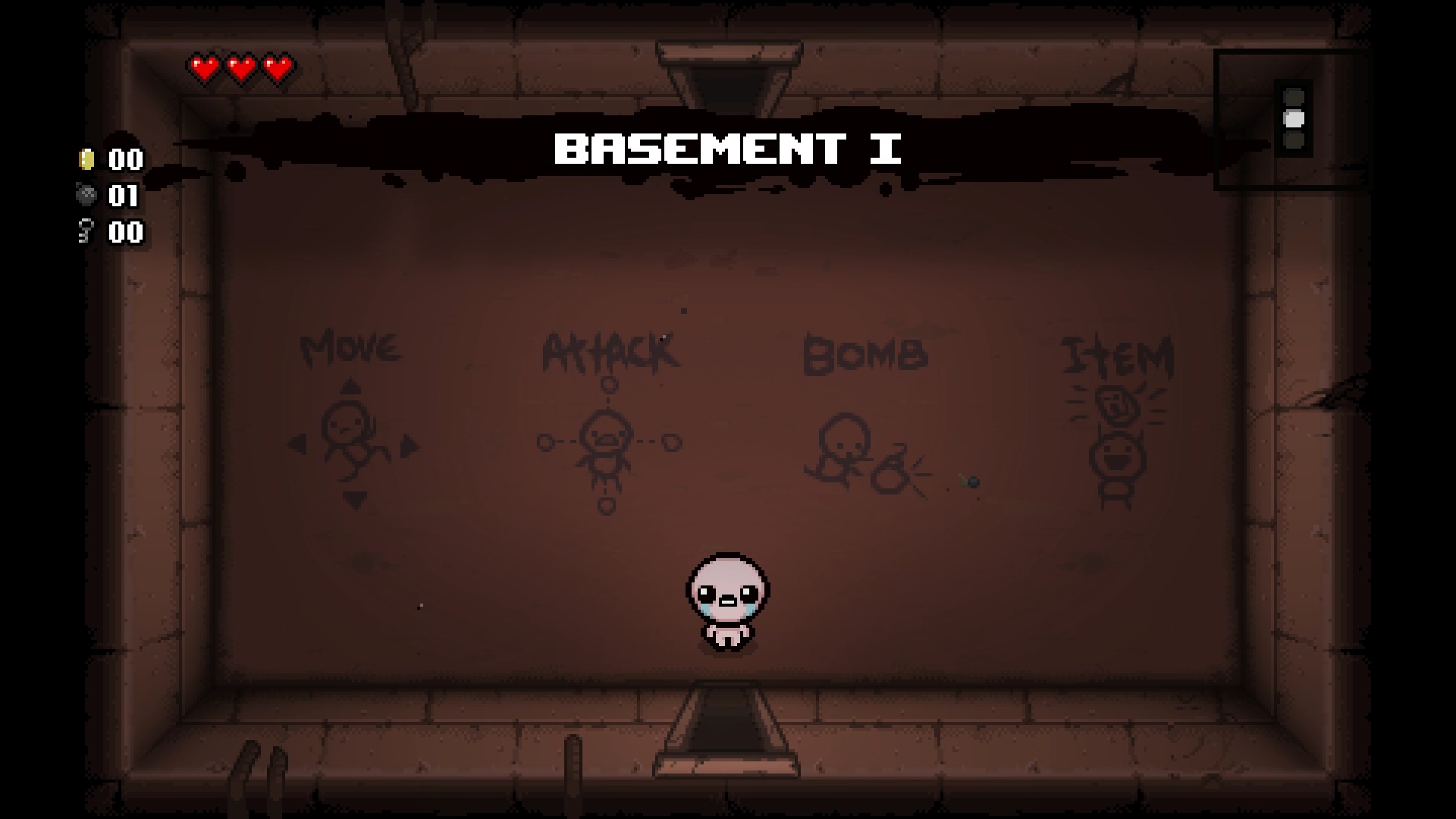
How do I approach such a massive product… well, might as well start with the beginning. The Binding of Isaac is a game that was developed by Edmund McMillen and Florian Himsl, and released in its first version as a Flash game on September 28th, 2011. The game’s popularity quickly rose, leading to an expansion titled “Wrath of the Lamb”. However, the version most people are familiar with is the remake, developed with help from the game studio Nicalis on a new engine, dubbed “The Binding of Isaac: Rebirth” and released to Steam on November 4th, 2014 (this is the version I’m covering today). Multiple content packs were added afterwards, such as Afterbirth, Afterbirth+ and, last year, Repentance. Since there is a LOT of ground to cover, I'll focus on Rebirth and only mention notable differences with later DLCs whenever necessary.


A brief introduction

Though the game is fairly well-known, in case someone reading this doesn’t know, I’ll explain: In short, The Binding of Isaac is a roguelike, meaning that you explore dungeons that are procedurally generated. A run you go through is defined by its "seed", a sequence of letters and numbers that’s randomized at the start of the game. In the case of The Binding of Isaac, it’s a sequence of eight digits and excludes the characters 5, I, O and U, meaning that there are (3281,099,511,627,776 possible dungeons. Any more and I would have needed scientific notation. The odds of playing through the same dungeon layout twice (without tools, hacks, or by generating a precise seed by yourself) are so low, it’s practically impossible.