Watch me on Twitch!

Streaming on Twitch whenever I can. (Subscribe to my channel to get notifications!)

September 1, 2023

Quick Review: Squirbs


“Double trouble” has never been truer.

Made by Team Indev and released to Steam on January 6th, 2016, Squirbs is the story of… well… the Squirbs. One of them, feeling heroic one day, touches the Universe Crystal and shatters it. This literally split the world, as well as its inhabitants, in two halves that always do the exact same things at the same time. Your Squirb feels the need to correct his mistake, so he (and his split double) decides to gather the shards of the Crystal and restore the world.

Just one of so many grueling platform challenges.
This concept, which starts out deceptively simple, gets complicated fast. Controls are basic: Arrows to move, Space to jump, R to restart a stage, that’s all you need. Both characters move in the same direction, at the same time. They’ll also both jump if they’re on solid ground; if one is in midair already, only the other will jump. If one is stopped by a wall, but the other can still walk, it will. The main challenge here really is to keep your eyes on both Squirbs, since the hazards will be different on both sides. As an example, if one lands on solid ground, maybe the other lands on water… or worse even, on spikes, killing both. Brutally, too; they’ll literally explode into a splatter of guts and blood.

So. Much. Blood.
Needless to say, trial-and-error gameplay is strongly encouraged. Achievements are earned for dying 10, 100 and 1000 times; this tells you exactly what type of game this is. There’s one more for finishing every area: Forest, Castle, Ice Mountains and Underground. And a last one for finishing all four. Much like other puzzle platformers (and I’ve played a lot of those lately!), elements soon start piling up. Spikes? Lasers? Treadmills? Teleporters? Floors that are sticky and prevent jumping, floors that allow super-jumping, walls that allow for double jump? Cannons? Special pads that reverse the direction in which one Squirb walks? It just gets crazier at every turn.

A point comes, really quickly, where you need perfect-pixel precision in order to reach the shards. The smallest mistake or misstep, and boom, the Squirbs paint the world with their innards. It’s gonna happen a lot. A lot a lot. Having your attention split definitely doesn’t help. Usually, what kills you is something you didn’t see coming because you were focused on the other half.

Yeah, I'm just repainting the whole damn place
with a nice, thick coat of red paint.

It's not the cannonballon the right that kills you.
It's the spike on the left.
The graphics are fine; about as simple as can get. The music, however… well, instead of each world having its own track or set of tracks, the whole game cycles through its small number of songs. It robs these worlds of one thing that could help make them unique. Minor nitpick, but it does highlight that presentation wasn’t as important as gameplay. (Might be why I feel so weirded out by the gory explosions whenever Squirbs die; it feels so out of place with everything else, and I can’t tell whether it was on purpose for comedy, or just shoved in there without much thought.)

Geez, good thing there's those sticky floors here.
This one’s okay. The concept is interesting and implemented in many clever ways. The difficulty goes quickly through the roof, so if you boot this one up, be ready for a major challenge. Eventually, the stages require such precision that you have to measure every single step and action you take, and sometimes you barely have time to adapt. It’s insanely tough. It does all the most common (borderline tired) puzzle platformer tropes as well, though a lot of these are made trickier by the set-up of controlling two characters at once. Ultimately, this one is more interesting in concept than in presentation. Not really bad, and good for a try if you want to sink your teeth into a tough one, but other than that (and its low price), there’s not much to it.

Squirbs is available on Steam for 0.99$ USD.

August 30, 2023

Quick Review: On Rusty Trails


The hate between the reds and the blues... it’s gotta stop, man. The skies are literally falling on our heads.

See Elvis? He's the triangle. Down there.
Wait, I'll get the magnifying glass...
Black Pants Studio presents On Rusty Trails, released on June 13th, 2016. It is the story of Elvis, a triangular little (and I do mean little) red robot whose home gets destroyed during a shower of deadly green meteorites. Thankfully, the house was still under warranty, so he hurries off to get a brand new one from the factory. There’s only one problem. Well… two. First, there’s an intense hatred between his kin and the blue tentacular blobs, who begrudgingly coexist in a world that tries to accommodate all but just ends up making it dangerous for both; and second, the meteorites haven’t stopped falling.

In this tough 2D puzzle platformer, Elvis has a lot of skills. The first: As far as platforming protagonists go, Elvis has incredible mobility. Maybe he’s a robot with magnetic feet, I dunno; but he can stick to all four sides of any surface. You thus control him on solid ground, up walls, even under the cubes. Takes some getting used to, but it's a major element.

At least the blue costume fools everyone.

The second skill is gained early on: A “blue creature” suit that he can put on or take off in an instant. This allows him to walk incognito among the blue creatures. However, it’s not used to get through racial conflicts between the red triangles and blue beasts; no, it’s more that this world is a deadly goddamn mess. Most platforming elements are made either for one or for the other. Elvis can swap between his red and blue forms at the press of the tab key, and radically changes the game each time.

Laser good? Only when I'm red.
Red platforms are only solid for his red form, and vice versa for the blue. While red, Elvis can walk through lava and even pass lasers without an issue, but waterfalls will instantly kill him. Meanwhile, the blue suit allows him to survive under the same waterfalls but makes him vulnerable to lava and lasers. Thus, to progress, you have to regularly swap between the two forms, which switches both the platforms available and the deadly hazards on the way. This even applies to the elevator at the end of every stage – you’re in the blue form, the elevator asks for red? You can’t come in.

Oh, and remember when I said that the green meteorites haven’t stopped falling? Yeah, doesn’t matter which form you’re in; you touch ‘em, you’re dead. Keep in mind that Elvis dies in one hit. Oh, and sometimes, those green things move, as well. Good luck. You’ll need it. Needless to say, things only get harder and harder from there.

I'm starting to feel a little more worried that, not only are
those green things still around, someone is turning them into
moving hazards in the neighborhood.

And the rain clouds move of their own free will?
Half the people in this world die from water!
I wanna speak to the manager of this universe!
On Rusty Trails is a game that’s highly stylized, looking great and having great music to accompany what we have on the screen. There’s a good amount of variety topping the basic concept here. One thing I do criticize about the look of the game is that, sometimes, we’re zoomed out from the game, and in those cases, Elvis is so small that we can barely see him on the screen. Makes it tricky to avoid hazards. The themes are pretty clear and the story goes to interesting places; after Elvis goes through a neighborhood that’s a failed attempt at having reds and blues living together (as evidenced by billboards encouraging it having been vandalized repeatedly), he enters the factory… and something even fishier is going on in there.

There's even the occasional puzzle-based boss
battle in there, as well!
There’s a fantastic complexity to the system here – even if it’s just about switching between two forms, this changes the world considerably every time you do. Very frequently, you face hazards that force you to switch literally for a split second, the time to get past it and return to the other form. Speed is encouraged, with each stage keeping track of your time and comparing it to literally everyone else who's ever played through it (thousands of players). The puzzle aspect is all about getting to the goal, which can be very tricky between all the red and blue platforms and the deadly green meteorites, and figuring out the right timing. The difficulty is high. It’s definitely a game for someone seeking a challenge. If that sounds like what you’d like, by all means, do check it out!

On Rusty Trails is available on Steam for 14.99$ USD.

August 28, 2023

Quick Review: Narcissu 1st and 2nd


No, I’m not crying, you’re crying.

A creation of stage-nana published by Sekai Project and released on May 15th, 2007, Narcissu 1st and 2nd is a visual novel that veers far more on the “novel” side. It’s hardly interactive; outside of selecting the new chapter when that screen comes up, there’s nothing here but the story and its progression, with some voice acting.

The size of the pictures, within that big void
of black... it feels a tad claustrophobic.

700km? A decent road trip challenge for
some people who've never seen the world.
This product is a double pack, hence the name. Narcissu 1st is about an unnamed 20yo boy with a disease that’s never stated clearly in the story, all but left to die at the “seventh floor” of the local hospital. The hopeless cases, who will go back and forth between that floor and home, just waiting for the inevitable. Which never takes too long to come. During one of those boring days, the boy gets acquainted with a girl staying there as well, Setsumi Sakura, also suffering from an unstated disease, who seems disinterested in everything and resigned to accept her fate and basically stop living. Dying here, or dying at home… Faced with those depressing clear-cut choices, the protagonist gets a crazy idea for a third option, which Setsumi ends up joining on. Impromptu road trip? Impromptu road trip.

Narcissu 2nd is actually a prequel to the first, and over double the length, for a total of about 6 hours for both. Its protagonist is Himeko, originally a volunteer at the seventh floor, who also winds up diagnosed with a deadly disease and transferred there. She meets Setsumi, making the girl the tying element between the two Sides, and a friendship develops there as well. Road trip? Road trip. (Yeah, don’t ask me to explain either of these.)

It's sad when a hospital room seems like the
preferable option.

Lots of "Un." "Not particularly." and other
repeated phrases here.
Both games are available in both voiced and unvoiced versions, and with two translations – those were done by separate translators, so there are small differences between them. The presentation is minimalist; we rarely get to see the characters on the theater-wide strip above the text, and we instead get a lot of visuals of places without characters in them. The intention was to let the players fill in with their imagination (though we do get a few glimpses of the protagonists from time to time). The voice acting is still in the original Japanese, and is a lot more present in the second story than in the first. Both pack a fair number of emotional punches; it is, after all, a story of dying people, many of whom have already learned to cope with their situation. That said, the story is not kind to the health system in Japan, though as you can imagine, in a story that’s tied this closely to it, commentary on the subject was inevitable. Long story short, if the story does hook you in, then it will tug at your heartstrings more than just a few times.

Narcissu 1st and 2nd is available for free on Steam. If you were touched by the story, you might also like the 10th anniversary anthology project that includes a number of extra stories as DLCs and a lot of bonuses.

August 23, 2023

Quick Review: Mushroom 11


An… anti-platformer? …What’s that? Sorry, I got kinda puzzled by that descriptor on the Steam page.

Weird to think that you're technically the
eraser, not the blob itself.
A product by Untame released on October 15th, 2015, Mushroom 11 is set in a post-apocalyptic future. Mankind is practically gone, only its ruins remain, as well as whatever has survived and mutated. The strangest mutation of all, though, is a bizarre green blob, an amorphous organism, suddenly born out of who knows what. A mushroom, maybe? This thing cannot further grow, and also it cannot quite move on its own. That’s where you come in.

Fire bad! Good thing Blobby feels no pain!
You are the eraser. Left-click to erase a big circle of bloblike material, right-click to erase a smaller portion. The main gameplay mechanic here is that, when you erase a part of the blob, it grows it back elsewhere. Even if you quickly erase the whole thing, there’ll be one particle of the blob left that it can grow back from. There is only one requirement: To grow back, the blob has to touch solid ground, stationary items or water. It can’t grow in midair. Also of note is how the blob’s regrowth seems completely randomized; you have no control on how its particles return, aside from keeping the eraser active so that particles won’t grow in its circle. Part of the challenge is thus that your control on the thing’s movements are very limited, meaning that you have few options when it comes to making it go where you want.

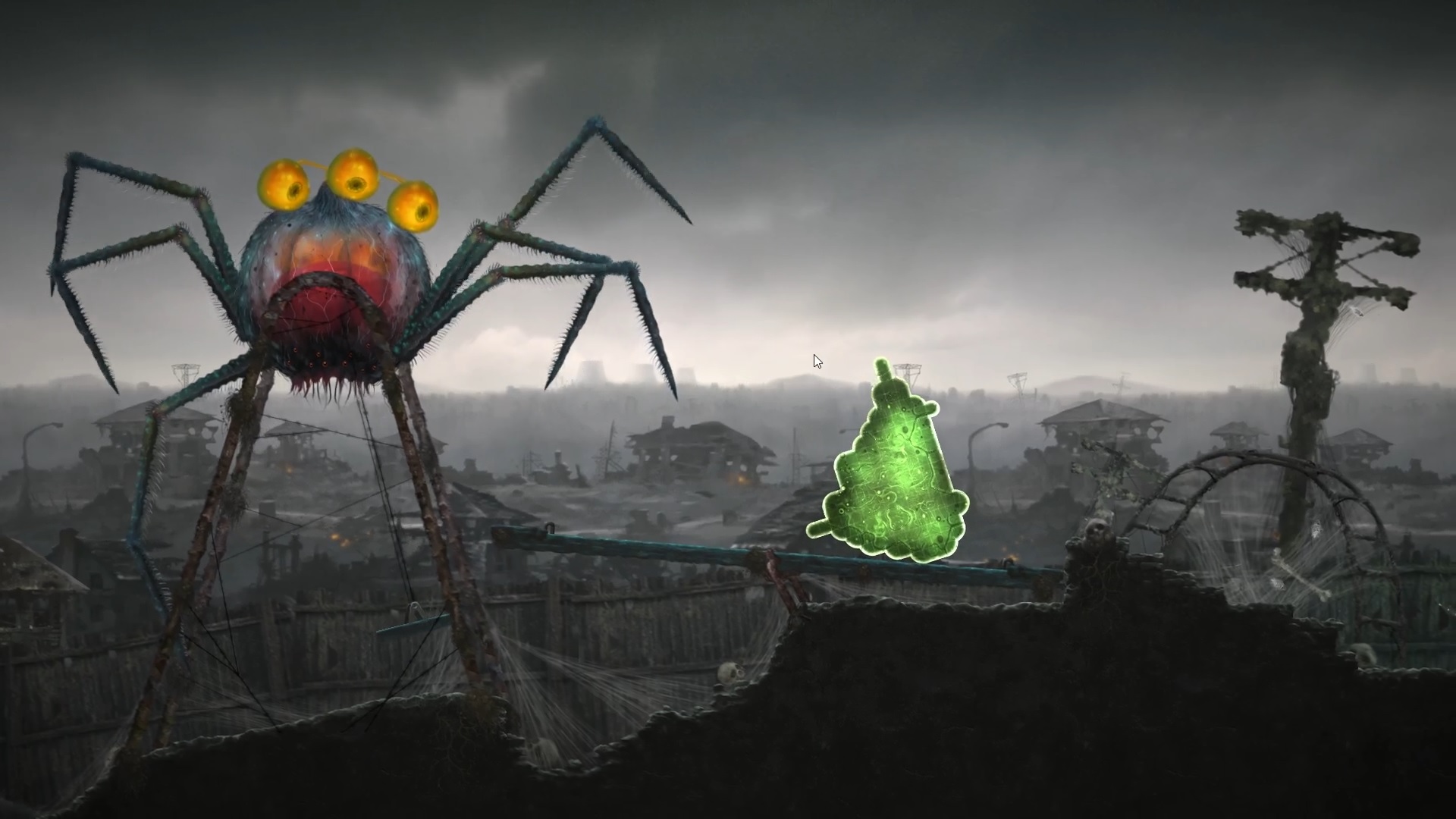
Blobby VS the Spider-Thing.
My money's on the amoeba.
The game is divided into chapters, with each one upping the ante on tricky and inventive puzzles. Shoving the blob through a maze of tight passages? Sure. Having it cross areas of open lava? Of course! Fight radiated monsters? That too! One quest added to the game involves gathering as many DNA strands as possible, which is done by picking up special insects and plants. Customary of a good puzzle game, most of those aren’t mandatory but may require some extra thinking in order to actually grab them. Those are tallied at the end of a chapter.

The DNA strands allow for a variation in gameplay, as they become weak points on bosses encountered at the end of a chapter – gather all of the strands, the boss is killed. On a similar note, there are enemies, but since the blob is mostly indestructible, pieces of it destroyed by an enemy or a hazard (if it’s not destroyed in its entirety, that is) will reappear elsewhere on it, similarly to the eraser circle. This thing just won’t die – but it wants to travel.

Science lesson of the day: Levers, pulleys and catapults!

The next scientific question: Can an amoeba rope-climb?
Answer: Yes, but it'll be hella tricky.
Although I didn’t finish it (yet), I can safely say Mushroom 11 represents exactly what I wished all puzzle platformers were: An incredibly unique concept and gameplay mechanic, put through puzzles that take full advantage of everything that can be done with the idea. Adding more mechanics on top and seeing how those mix up. The amoeba’s randomized regeneration makes it extremely unwieldy, and forces it to count on gravity to move around (erase the back side of it, the front becomes heavy, it tumbles forwards, rinse and repeat). Since your only controls involve erasing the amoeba, you can split it into pieces, often allowing it to fulfill more than one task at a time. For movement, the big eraser is very useful, but when finesse is required (example: When climbing a rope in the late stages of the third chapter), the small eraser is a godsend.

I wasn't expecting to fight a shrimp-powered robot
today, yet here we are. Weird days.
The music is perfect for the mood, and the world around our unlikely protagonist (if we can call it that) represents well the somber idea of a fresh post-humanity world. Not everything is dead, but whatever still lives is trapped in a mechanical nuclear wasteland. So many hints of what existed before the current situation. All those graffiti on the walls. The warning signs, deep into the deserted factories. Those monsters standing at the end of every chapter… Speaking of, the chapters are very long and can easily take from 20 to 40 minutes to finish, depending on how good you are at “controlling” the amoeba. That goes for all 7 chapters, so there’s quite a bit of game here.  Side-note, I think I would have liked if gathering the DNA strands made a difference, like if it added a single cell to the blob each time – making a difference in the end. If the concept sounds right up your alley, then by all means, check it out.

Mushroom 11 is available on Steam for 14.99$ USD.

August 18, 2023

Quick Review: The Murder of Sonic The Hedgehog


SEGA won this year’s April Fools, no contest.

Actually released on March 31st, 2023, this official SEGA game (yes, really) is a visual novel for the Sonic franchise (yes, really) that opens with the premise of Sonic the Hedgehog getting murdered. Yes, really. …Did I stutter? You’ve seen the title, haven’t you?

Meanwhile, Tails hopes he's not getting trolled again.

I'm so glad to be playing a Sonic game featuring so many
characters from the franchise. I wished that happened more
often. Also, is that a "printed comic book" effect?
Well, okay, some context. It’s Amy Rose’s birthday, and she always does something special to celebrate. So she has invited Sonic, Tails, Knuckles, Blaze, Rouge, Shadow, Espio and Vector to a special murder mystery game on a high-tech speed train. Everybody’s playing a role. The train’s conductor is… well, busy conducting, leaving the new hire, an awkwardly average quokka, to tend to the guests’ needs. The game takes a strange turn when it’s Sonic who is found “dead” in the end wagon despite having been assigned the conductor’s cabin. At first, Tails and Amy think it’s him playing his part for Amy’s party. The quokka, however, notices that the famous hero is much more banged-up and feeble than he should be… especially for make-believe! He might even be dead, for real! They thus decide to become Tails’ sidekick, and lend a hand in solving the mystery.

(Side-note: The quokka, unofficially called Barry by promotional material [though you name them at the start of the story], is adorable and I want a plushie of them. Get them as an NPC in more games, dagnabbit!)

Apologies. It may seem I produced a sound that was a failed
attempt at a squee.

....Nothing! Please don't punch me or Tails. Nice hat BTW!
The visual novel half is incredibly well-made. Embodying all the humor we know from the Sonic series and made by the Sonic social media team, with one of the game’s lead artists, Min Ho Kim, having worked on a spin-off miniseries in Sonic’s IDW Comics run. Packed with in-jokes and references pertaining to the Sonic franchise’s 32 years of existence, the game actually has a really good story with twists and turns and genuinely great character interactions. This is one of the rare few pieces of official Sonic media where you could see some secondary characters interact with each other, like Rouge and Blaze. Or have so many secondary characters be relevant to the story at hand. There’s a  bit of Ace Attorney inspiration here as well, presenting evidence and coming to logical conclusions…

Rouge, can you stop treasure-hunting for two seconds?
Apparently not.

Oh hey, the console even has my name on top. Cute!
The other half is the DreamGear, known as the THINK! Levels, which represent the quokka’s thought process when they have to work their brain more than usual to reach conclusions. It’s done through a mini-game in which Sonic runs and jumps through an obstacle course and has to get a certain number of rings before the end goal, which is a lightbulb. Barry, or whatever your name is, buddy, if it takes you that long to go through a logical thinking process, you might be a little slow. But you’re adorable so I’ll let it slide. Those segments start out pretty simple but get progressively tougher as the story advances, with them being omnipresent, and very tough, in the final stretch. In an effort to make the game accessible to all, a set of options allows you to make Sonic invincible, remove all pitfalls, slow the game down or reduce the number of rings needed, making these sequences easier if you want. You can even make them impossible to lose, if you'd rather focus solely on the story.

As the hazards pile up, the THINK! levels get more and more
difficult. Crumbling ground, shuriken, spikes everywhere!

Nothing like finishing a THINK! stage and missing only one
or two rings from the required total.
Legit a great game, good in all the ways it could be. Crisp writing, superb art, excellent interactions between characters, a lot of comedy, a lot of heart, some fun twists, challenging running stages for those who like them, with accessibility options for those who’d rather have it easy. Perhaps the closest we’ll get to the feel of the comics and other continuities of the multimedia Sonic franchise that’s normally separated from the main continuity of the games. Really great. Worth your time (it’s short, can be beaten in two to three hours), and free, to top it off.

What are you waiting for? Go download it, right now!